ISO 2493-1:2010
ISO 2493-1:2010

ISO 2493-1:2010

November 2010
International standard Current

Paper and board — Determination of bending resistance — Part 1: Constant rate of deflection

ISO 2493-1:2010 specifies procedures, based on the two-point loading principle, for determining the bending resistance of paper and board.ISO 2493-1:2010 applies to the measurement of the bending resistance within the range 20 mN to 10 000 mN. It is not applicable to corrugated board but can be applicable to the components of such board.The bending angle is 15° and the bending length is 50 mm.For samples having a bending resistance that is too low to measure with a bending length of 50 mm, a shorter bending length, i.e. 10 mm, can be used. For boards that tend to be permanently deformed if bent through 15°, the half bending angle, i.e. 7,5°, can be used.


View the extract
Main informations

Collections

International ISO standards

Publication date

November 2010

Number of pages

8 p.

Reference

ISO 2493-1:2010

ICS Codes

85.060   Paper and board

Print number

1
Sumary
Paper and board — Determination of bending resistance — Part 1: Constant rate of deflection

ISO 2493-1:2010 specifies procedures, based on the two-point loading principle, for determining the bending resistance of paper and board.

ISO 2493-1:2010 applies to the measurement of the bending resistance within the range 20 mN to 10 000 mN. It is not applicable to corrugated board but can be applicable to the components of such board.

The bending angle is 15° and the bending length is 50 mm.

For samples having a bending resistance that is too low to measure with a bending length of 50 mm, a shorter bending length, i.e. 10 mm, can be used.

For boards that tend to be permanently deformed if bent through 15°, the half bending angle, i.e. 7,5°, can be used.
Replaced standards (1)
ISO 2493:1992
ISO 2493:1992
September 1992
International standard Cancelled
Paper and board. Determination of resistance to bending.

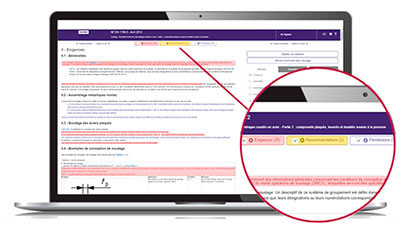
ZOOM ON ... the Requirements department

To comply with a standard, you need to quickly understand its issues in order to determine its impact on your activity.

The Requirements department helps you quickly locate within the normative text:

  • mandatory clauses to satisfy,
  • non-essential but useful clauses to know, such as permissions and recommendations.

The identification of these types of clauses is based on the document "ISO/IEC Directives, Part 2 - Principles and rules of structure and drafting of ISO documents" as well as on a constantly enriched list of verbal forms.

With Requirements, quickly access the main part of the normative text!


Need to identify, monitor and decipher standards?