ISO 2507:2026

ISO 2507:2026

January 2026
International standard Current

Thermoplastics pipes and fittings - Vicat softening temperature - General test method and test conditions for vinyl chloride-based (PVC-U, PVC-C, PVC-HI) and acrylonitrile-based (ABS, ASA) pipes and fittings

This document specifies a specific method for determining the Vicat softening temperature (VST) of thermoplastics pipes and fittings. It includes the adaption of method B 50 of ISO 306:2022 using a force of 50 N and a heating rate of 50 °C/h and the procedure for specimen preparation.It includes the particular test conditions for determining the Vicat softening temperature (VST) of unplasticized poly(vinylchloride) (PVC-U) or chlorinated poly(vinylchloride) (PVC-C) pipes and fittings, for high impact resistance poly(vinylchloride) (PVC-HI) pipes and for acrylonitrile/butadiene/styrene (ABS) and acrylonitrile/styrene/acrylic ester (ASA) pipes and fittings.This document can also be used for pipes and fittings from other materials (e.g. PE-UHMW).

View the extract
Main informations

Collections

International ISO standards

Publication date

January 2026

Number of pages

9 p.

Reference

ISO 2507:2026

ICS Codes

23.040.45   Plastics fittings
23.040.20   Plastics pipes

Print number

1
Sumary
Thermoplastics pipes and fittings - Vicat softening temperature - General test method and test conditions for vinyl chloride-based (PVC-U, PVC-C, PVC-HI) and acrylonitrile-based (ABS, ASA) pipes and fittings

This document specifies a specific method for determining the Vicat softening temperature (VST) of thermoplastics pipes and fittings. It includes the adaption of method B 50 of ISO 306:2022 using a force of 50 N and a heating rate of 50 °C/h and the procedure for specimen preparation.

It includes the particular test conditions for determining the Vicat softening temperature (VST) of unplasticized poly(vinylchloride) (PVC-U) or chlorinated poly(vinylchloride) (PVC-C) pipes and fittings, for high impact resistance poly(vinylchloride) (PVC-HI) pipes and for acrylonitrile/butadiene/styrene (ABS) and acrylonitrile/styrene/acrylic ester (ASA) pipes and fittings.

This document can also be used for pipes and fittings from other materials (e.g. PE-UHMW).
Replaced standards (3)
ISO 2507-1:1995
February 1995
International standard Cancelled
Thermoplastics pipes and fittings. VICAT softening temperature. Part 1 : general test method.

The method specified is based on determining the temperature at which a standard indenter, under a force of 50 N ± 1 N, penetrates 1 mm into the surface of a test piece cut from the wall of a pipe or fitting while the temperature is raised at a constant rate. Is applicable only to thermoplastics materials for which it is possible to measure the temperature at which the rate of softening becomes rapid. Is based on ISO 306:1994 which, however, applies to materials in the form of sheets.

ISO 2507-2:1995
February 1995
International standard Cancelled
Thermoplastics pipes and fittings. VICAT softening temperature. Part 2 : test conditions for unplasticized poly(vinyl chloride) (PVC-U) or chlorinated poly(vinyl chloride) (PVC-C) pipes and fittings and for high impact resistance poly(vinyl chloride) (PVC-Hi) pipes.

Specifies the particular test conditions for determining the Vicat softening temperature of PVC-U and PVC-C pipes and fittings as well as PVC-HI pipes (the general test method is given in ISO 2507-1). Also gives, for information, the corresponding basic specifications.

ISO 2507-3:1995
February 1995
International standard Cancelled
Thermoplastics pipes and fittings. VICAT softening temperature. Part 3 : test conditions for acrylonitrile/butadiene/styrene (ABS) and acrylonitrile/styrene/ester (ASA) pipes and fittings.

Specifies the particular test conditions for determining the Vicat softening temperature of ABS and ASA pipes and fittings (the general test method is given in ISO 2507-1). Also gives, for information, the corresponding basic specifications.

ZOOM ON ... the Requirements department
To comply with a standard, you need to quickly understand its issues in order to determine its impact on your activity.

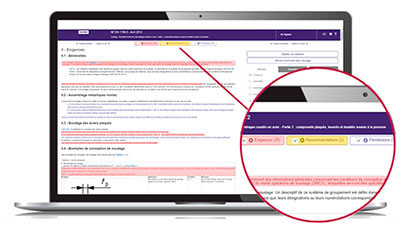
The Requirements department helps you quickly locate within the normative text:
- mandatory clauses to satisfy,
- non-essential but useful clauses to know, such as permissions and recommendations.

The identification of these types of clauses is based on the document “ISO / IEC Directives, Part 2 - Principles and rules of structure and drafting of ISO documents ”as well as on a constantly enriched list of verbal forms.

With Requirements, quickly access the main part of the normative text!

With Requirements, quickly access the main part of the normative text!
Need to identify, monitor and decipher standards?

COBAZ is the simple and effective solution to meet the normative needs related to your activity, in France and abroad.

Available by subscription, CObaz is THE modular solution to compose according to your needs today and tomorrow. Quickly discover CObaz!

Request your free, no-obligation live demo

I discover COBAZ