ISO 2719:2025
ISO 2719:2025

ISO 2719:2025

November 2025
International standard Current

Determination of flash point - Pensky-Martens closed cup method

This document specifies three procedures, A, B and C, using the Pensky-Martens closed cup tester, for determining the flash point of combustible liquids, liquids with suspended solids, liquids that tend to form a surface film under the test conditions, biodiesel and other liquids in the temperature range of 40 °C to 370 °C.NOTE 1        Although, technically, kerosene with a flash point above 40 °C can be tested using this document, it is standard practice to test kerosene according to ISO 13736.[5] Similarly, lubricating oils are normally tested according to ISO 2592.[2]Procedure A is applicable to distillate fuels (diesel, biodiesel blends, heating oil and turbine fuels), new and in-use lubricating oils, paints and varnishes, and other homogeneous liquids not included in the scope of procedures B or C.Procedure B is applicable to residual fuel oils, cutback residuals, used lubricating oils, mixtures of liquids with solids, and liquids that tend to form a surface film under test conditions or are of such kinematic viscosity that they are not uniformly heated under the stirring and heating conditions of procedure A.Procedure C is applicable to fatty acid methyl esters (FAME) as specified in specifications such as EN 14214[11] or ASTM D6751.[13]This document is not applicable to water-borne paints and varnishes.NOTE 2        Water-borne paints and varnishes can be tested using ISO 3679.[3] Liquids containing traces of highly volatile materials can be tested using ISO 1523[1] or ISO 3679.

View the extract
Main informations

Collections

International ISO standards

Publication date

November 2025

Number of pages

29 p.

Reference

ISO 2719:2025

ICS Codes

75.080   Petroleum products in general

Print number

1
Sumary
Determination of flash point - Pensky-Martens closed cup method

This document specifies three procedures, A, B and C, using the Pensky-Martens closed cup tester, for determining the flash point of combustible liquids, liquids with suspended solids, liquids that tend to form a surface film under the test conditions, biodiesel and other liquids in the temperature range of 40 °C to 370 °C.

NOTE 1        Although, technically, kerosene with a flash point above 40 °C can be tested using this document, it is standard practice to test kerosene according to ISO 13736.[5] Similarly, lubricating oils are normally tested according to ISO 2592.[2]

Procedure A is applicable to distillate fuels (diesel, biodiesel blends, heating oil and turbine fuels), new and in-use lubricating oils, paints and varnishes, and other homogeneous liquids not included in the scope of procedures B or C.

Procedure B is applicable to residual fuel oils, cutback residuals, used lubricating oils, mixtures of liquids with solids, and liquids that tend to form a surface film under test conditions or are of such kinematic viscosity that they are not uniformly heated under the stirring and heating conditions of procedure A.

Procedure C is applicable to fatty acid methyl esters (FAME) as specified in specifications such as EN 14214[11] or ASTM D6751.[13]

This document is not applicable to water-borne paints and varnishes.

NOTE 2        Water-borne paints and varnishes can be tested using ISO 3679.[3] Liquids containing traces of highly volatile materials can be tested using ISO 1523[1] or ISO 3679.

Replaced standards (2)
ISO 2719:2016
ISO 2719:2016
June 2016
International standard Cancelled
Determination of flash point - Pensky-Martens closed cup method

ISO 2719:2016 describes three procedures, A, B and C, using the Pensky-Martens closed cup tester, for determining the flash point of combustible liquids, liquids with suspended solids, liquids that tend to form a surface film under the test conditions, biodiesel and other liquids in the temperature range of 40 °C to 370 °C. CAUTION - For certain mixtures no flash point, as defined, is observed; instead a significant enlargement of the test flame (not halo effect) and a change in colour of the test flame from blue to yellowish-orange can occur. Continued heating can result in significant burning of vapours outside the test cup, and can be a potential fire hazard. NOTE 1 Although, technically, kerosene with a flash point above 40 °C can be tested using this International Standard, it is standard practice to test kerosene according to ISO 13736.[5] Similarly, lubricating oils are normally tested according to ISO 2592[2]. Procedure A is applicable to distillate fuels (diesel, biodiesel blends, heating oil and turbine fuels), new and in-use lubricating oils, paints and varnishes, and other homogeneous liquids not included in the scope of Procedures B or C. Procedure B is applicable to residual fuel oils, cutback residua, used lubricating oils, mixtures of liquids with solids, liquids that tend to form a surface film under test conditions or are of such kinematic viscosity that they are not uniformly heated under the stirring and heating conditions of Procedure A. Procedure C is applicable to fatty acid methyl esters (FAME) as specified in specifications such as EN 14214[11] or ASTM D6751[13]. ISO 2719:2016 is not applicable to water-borne paints and varnishes. NOTE 2 Water-borne paints and varnishes can be tested using ISO 3679[3]. Liquids containing traces of highly volatile materials can be tested using ISO 1523[1] or ISO 3679.


ISO 2719/A1:2021
ISO 2719/A1:2021
March 2021
International standard Cancelled
Amendment 1 to standard ISO 2719:2016

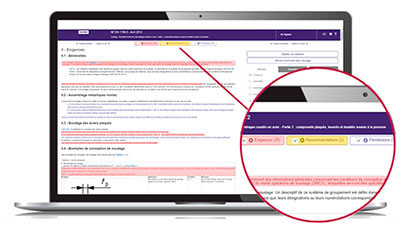
ZOOM ON ... the Requirements department

To comply with a standard, you need to quickly understand its issues in order to determine its impact on your activity.

The Requirements department helps you quickly locate within the normative text:

  • mandatory clauses to satisfy,
  • non-essential but useful clauses to know, such as permissions and recommendations.

The identification of these types of clauses is based on the document "ISO/IEC Directives, Part 2 - Principles and rules of structure and drafting of ISO documents" as well as on a constantly enriched list of verbal forms.

With Requirements, quickly access the main part of the normative text!


Need to identify, monitor and decipher standards?