ISO 27799:2025
Health informatics - Information security controls in health based on ISO/IEC 27002
This document provides information security controls, including implementation guidance, for health organizations. It is based on ISO/IEC 27002:2022In addition to generic ICT equipment and software used in many other environments, the scope of this document includes software and systems specifically for healthcare, such as electronic health record systems and medical devices incorporating health software. Such medical devices can be programmed or programmable and can contain software, firmware or both.Other digital equipment (such as that for environmental and infection control, building management, and physical security), which can be used in premises where healthcare is provided, is also in scope.This document applies to information in all its aspects, whatever form the information takes (including text and numbers, sound recordings, drawings, images and video), by whatever means it has been acquired or captured, whatever means are used to store it (such as printing or writing on paper or storage electronically), and whatever means are used to transfer or exchange it (orally, by hand, by post, movement of storage media, direct links or networking).This document is for organizations of all types and sizes that provide healthcare or are custodians of personal health information for other reasons. The information that they are responsible for can be stored and processed in many possible ways and locations, including on premises or in the cloud, but remains in scope.This document applies to all physical settings where healthcare is intended to be delivered, such as hospitals, clinics and other locations or facilities designated for healthcare purposes such as ambulances and mobile imaging or diagnostic units. It also applies to care provided elsewhere, such as in residential premises. In addition to the range of settings, this document applies to all methods of service provision including remote or virtual healthcare.
This document provides information security controls, including implementation guidance, for health organizations. It is based on ISO/IEC 27002:2022
In addition to generic ICT equipment and software used in many other environments, the scope of this document includes software and systems specifically for healthcare, such as electronic health record systems and medical devices incorporating health software. Such medical devices can be programmed or programmable and can contain software, firmware or both.
Other digital equipment (such as that for environmental and infection control, building management, and physical security), which can be used in premises where healthcare is provided, is also in scope.
This document applies to information in all its aspects, whatever form the information takes (including text and numbers, sound recordings, drawings, images and video), by whatever means it has been acquired or captured, whatever means are used to store it (such as printing or writing on paper or storage electronically), and whatever means are used to transfer or exchange it (orally, by hand, by post, movement of storage media, direct links or networking).
This document is for organizations of all types and sizes that provide healthcare or are custodians of personal health information for other reasons. The information that they are responsible for can be stored and processed in many possible ways and locations, including on premises or in the cloud, but remains in scope.
This document applies to all physical settings where healthcare is intended to be delivered, such as hospitals, clinics and other locations or facilities designated for healthcare purposes such as ambulances and mobile imaging or diagnostic units. It also applies to care provided elsewhere, such as in residential premises. In addition to the range of settings, this document applies to all methods of service provision including remote or virtual healthcare.
ISO/TS 14441:2013 examines electronic patient record systems at the clinical point of care that are also interoperable with EHRs. ISO/TS 14441:2013 addresses their security and privacy protections by providing a set of security and privacy requirements, along with guidelines and best practice for conformity assessment. ISO/TS 14441:2013 includes a cross-mapping of 82 security and privacy requirements against the Common Criteria categories in ISO/IEC 15408 (all parts).
ISO 27799:2016 gives guidelines for organizational information security standards and information security management practices including the selection, implementation and management of controls taking into consideration the organization's information security risk environment(s). It defines guidelines to support the interpretation and implementation in health informatics of ISO/IEC 27002 and is a companion to that International Standard. ISO 27799:2016 provides implementation guidance for the controls described in ISO/IEC 27002 and supplements them where necessary, so that they can be effectively used for managing health information security. By implementing ISO 27799:2016, healthcare organizations and other custodians of health information will be able to ensure a minimum requisite level of security that is appropriate to their organization's circumstances and that will maintain the confidentiality, integrity and availability of personal health information in their care. It applies to health information in all its aspects, whatever form the information takes (words and numbers, sound recordings, drawings, video, and medical images), whatever means are used to store it (printing or writing on paper or storage electronically), and whatever means are used to transmit it (by hand, through fax, over computer networks, or by post), as the information is always be appropriately protected. ISO 27799:2016 and ISO/IEC 27002 taken together define what is required in terms of information security in healthcare, they do not define how these requirements are to be met. That is to say, to the fullest extent possible, ISO 27799:2016 is technology-neutral. Neutrality with respect to implementing technologies is an important feature. Security technology is still undergoing rapid development and the pace of that change is now measured in months rather than years. By contrast, while subject to periodic review, International Standards are expected on the whole to remain valid for years. Just as importantly, technological neutrality leaves vendors and service providers free to suggest new or developing technologies that meet the necessary requirements that ISO 27799:2016 describes. As noted in the introduction, familiarity with ISO/IEC 27002 is indispensable to an understanding of ISO 27799:2016. The following areas of information security are outside the scope of ISO 27799:2016: a) methodologies and statistical tests for effective anonymization of personal health information; b) methodologies for pseudonymization of personal health information (see Bibliography for a brief description of a Technical Specification that deals specifically with this topic); c) network quality of service and methods for measuring availability of networks used for health informatics; d) data quality (as distinct from data integrity).
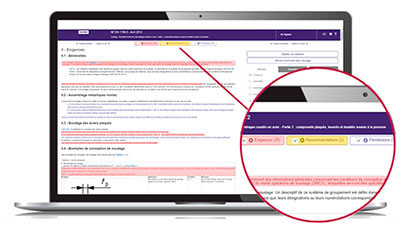
The Requirements department helps you quickly locate within the normative text:
- mandatory clauses to satisfy,
- non-essential but useful clauses to know, such as permissions and recommendations.
The identification of these types of clauses is based on the document “ISO / IEC Directives, Part 2 - Principles and rules of structure and drafting of ISO documents ”as well as on a constantly enriched list of verbal forms.
With Requirements, quickly access the main part of the normative text!

COBAZ is the simple and effective solution to meet the normative needs related to your activity, in France and abroad.
Available by subscription, CObaz is THE modular solution to compose according to your needs today and tomorrow. Quickly discover CObaz!
Request your free, no-obligation live demo
I discover COBAZ