ISO 28500:2017
Information and documentation - WARC file format
ISO 28500:2017 specifies the WARC file format:- to store both the payload content and control information from mainstream Internet application layer protocols, such as the HTTP, DNS, and FTP;- to store arbitrary metadata linked to other stored data (e.g. subject classifier, discovered language, encoding);- to support data compression and maintain data record integrity;- to store all control information from the harvesting protocol (e.g. request headers), not just response information;- to store the results of data transformations linked to other stored data;- to store a duplicate detection event linked to other stored data (to reduce storage in the presence of identical or substantially similar resources);- to be extended without disruption to existing functionality;- to support handling of overly long records by truncation or segmentation, where desired.
ISO 28500:2017 specifies the WARC file format:
- to store both the payload content and control information from mainstream Internet application layer protocols, such as the HTTP, DNS, and FTP;
- to store arbitrary metadata linked to other stored data (e.g. subject classifier, discovered language, encoding);
- to support data compression and maintain data record integrity;
- to store all control information from the harvesting protocol (e.g. request headers), not just response information;
- to store the results of data transformations linked to other stored data;
- to store a duplicate detection event linked to other stored data (to reduce storage in the presence of identical or substantially similar resources);
- to be extended without disruption to existing functionality;
- to support handling of overly long records by truncation or segmentation, where desired.
ISO 28500:2009 specifies the WARC file format: to store both the payload content and control information from mainstream Internet application layer protocols, such as the Hypertext Transfer Protocol (HTTP), Domain Name System (DNS), and File Transfer Protocol (FTP); to store arbitrary metadata linked to other stored data (e.g. subject classifier, discovered language, encoding); to support data compression and maintain data record integrity; to store all control information from the harvesting protocol (e.g. request headers), not just response information; to store the results of data transformations linked to other stored data; to store a duplicate detection event linked to other stored data (to reduce storage in the presence of identical or substantially similar resources); to be extended without disruption to existing functionality; to support handling of overly long records by truncation or segmentation, where desired.
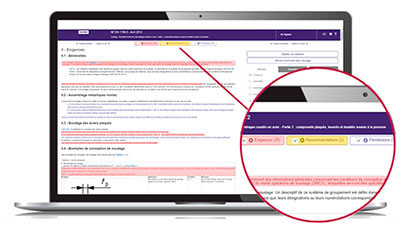
The Requirements department helps you quickly locate within the normative text:
- mandatory clauses to satisfy,
- non-essential but useful clauses to know, such as permissions and recommendations.
The identification of these types of clauses is based on the document “ISO / IEC Directives, Part 2 - Principles and rules of structure and drafting of ISO documents ”as well as on a constantly enriched list of verbal forms.
With Requirements, quickly access the main part of the normative text!

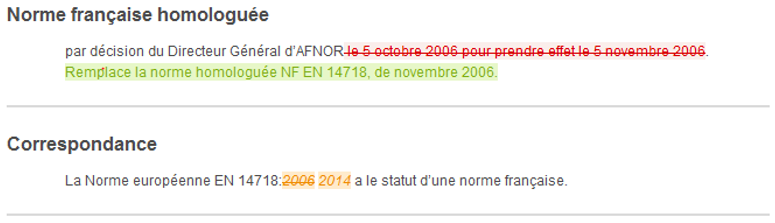
At a glance, you will be able to identify the additions, deletions or modifications to a text, table, figure and formula.

The Redlines + service is offered to you on the collection of French standards in force, in French language and in HTML and PDF format.
For an overview of the service, click on View a standard in redline format
COBAZ is the simple and effective solution to meet the normative needs related to your activity, in France and abroad.
Available by subscription, CObaz is THE modular solution to compose according to your needs today and tomorrow. Quickly discover CObaz!
Request your free, no-obligation live demo
I discover COBAZ