ISO 3744:2025

ISO 3744:2025

December 2025
International standard Current

Acoustics - Determination of sound power levels of noise sources using sound pressure - Engineering methods for an essentially free field over a reflecting plane

1.1        GeneralThis document specifies methods for determining the sound power level of a noise source from sound pressure levels measured on a surface enveloping the noise source (machinery or equipment) in an environment that approximates to an acoustic free field near one or more reflecting planes. The sound power level produced by the noise source, in frequency bands or with A-weighting applied, is calculated using those measurements.NOTE   Differently shaped measurement surfaces can yield differing estimates of the sound power level of a given noise source which are accounted for in the uncertainty associated with this test method. An appropriately drafted noise test code (see ISO 12001) gives detailed information on the selection of the surface.1.2        Types of noise and noise sourcesThe methods specified in this document are suitable for all types of noise (steady, non-steady, and fluctuating) as defined in ISO 12001, except for short duration, impulsive events.This document is applicable to all types and sizes of noise source (e.g. stationary or slowly moving component or sub-assembly), provided that the conditions for the measurements can be met.NOTE   It is possible that the conditions for measurements given in this document are impracticable for very tall or very long sources such as chimneys, ducts, conveyors and multi-source industrial plants. A noise test code for the determination of noise emission of specific sources can provide alternative methods in such cases.1.3        Test environmentThe test environments that are applicable for measurements made in accordance with this document can be located indoors or outdoors, with one or more sound-reflecting planes present on or near which the noise source under test is mounted. The ideal environment is a completely open space with no bounding or reflecting surfaces other than the reflecting plane(s), such as that provided by a qualified hemi-anechoic chamber, but procedures are given for applying corrections (within limits that are specified) in the case of environments that are less than ideal. Annex A or ISO 26101-2 specifies methods for determining the adequacy of the test environment and for determination of corrections to be applied to account for the effect of the test environment.1.4        Measurement uncertaintyInformation is given on the uncertainty of the sound power levels determined in accordance with this document, for measurements made in limited bands of frequency and with frequency A-weighting applied. Annex I specifies procedures for testing laboratories that can be used to reduce measurement uncertainty. The uncertainty conforms to ISO 12001, accuracy grade 2 (engineering grade). General information on measurement uncertainty is provided in this document and additional information can be found in ISO 5114-1[8].


View the extract
Main informations

Collections

International ISO standards

Publication date

December 2025

Number of pages

61 p.

Reference

ISO 3744:2025

ICS Codes

17.140.01   Acoustic measurements and noise abatement in general

Print number

2 - 22/01/2026
Sumary
Acoustics - Determination of sound power levels of noise sources using sound pressure - Engineering methods for an essentially free field over a reflecting plane

1.1        General

This document specifies methods for determining the sound power level of a noise source from sound pressure levels measured on a surface enveloping the noise source (machinery or equipment) in an environment that approximates to an acoustic free field near one or more reflecting planes. The sound power level produced by the noise source, in frequency bands or with A-weighting applied, is calculated using those measurements.

NOTE   Differently shaped measurement surfaces can yield differing estimates of the sound power level of a given noise source which are accounted for in the uncertainty associated with this test method. An appropriately drafted noise test code (see ISO 12001) gives detailed information on the selection of the surface.

1.2        Types of noise and noise sources

The methods specified in this document are suitable for all types of noise (steady, non-steady, and fluctuating) as defined in ISO 12001, except for short duration, impulsive events.

This document is applicable to all types and sizes of noise source (e.g. stationary or slowly moving component or sub-assembly), provided that the conditions for the measurements can be met.

NOTE   It is possible that the conditions for measurements given in this document are impracticable for very tall or very long sources such as chimneys, ducts, conveyors and multi-source industrial plants. A noise test code for the determination of noise emission of specific sources can provide alternative methods in such cases.

1.3        Test environment

The test environments that are applicable for measurements made in accordance with this document can be located indoors or outdoors, with one or more sound-reflecting planes present on or near which the noise source under test is mounted. The ideal environment is a completely open space with no bounding or reflecting surfaces other than the reflecting plane(s), such as that provided by a qualified hemi-anechoic chamber, but procedures are given for applying corrections (within limits that are specified) in the case of environments that are less than ideal. Annex A or ISO 26101-2 specifies methods for determining the adequacy of the test environment and for determination of corrections to be applied to account for the effect of the test environment.

1.4        Measurement uncertainty

Information is given on the uncertainty of the sound power levels determined in accordance with this document, for measurements made in limited bands of frequency and with frequency A-weighting applied. Annex I specifies procedures for testing laboratories that can be used to reduce measurement uncertainty. The uncertainty conforms to ISO 12001, accuracy grade 2 (engineering grade). General information on measurement uncertainty is provided in this document and additional information can be found in ISO 5114-1[8].
Replaced standards (1)
ISO 3744:2010
October 2010
International standard Cancelled
Acoustics - Determination of sound power levels and sound energy levels of noise sources using sound pressure - Engineering methods for an essentially free field over a reflecting plane

ISO 3744:2010 specifies methods for determining the sound power level or sound energy level of a noise source from sound pressure levels measured on a surface enveloping the noise source (machinery or equipment) in an environment that approximates to an acoustic free field near one or more reflecting planes. The sound power level (or, in the case of noise bursts or transient noise emission, the sound energy level) produced by the noise source, in frequency bands or with frequency A-weighting applied, is calculated using those measurements. The methods specified in ISO 3744:2010 are suitable for all types of noise (steady, non-steady, fluctuating, isolated bursts of sound energy, etc.) defined in ISO 12001. ISO 3744:2010 is applicable to all types and sizes of noise source (e.g. stationary or slowly moving plant, installation, machine, component or sub-assembly), provided the conditions for the measurements can be met. The test environments that are applicable for measurements made in accordance with ISO 3744:2010 can be located indoors or outdoors, with one or more sound-reflecting planes present on or near which the noise source under test is mounted. The ideal environment is a completely open space with no bounding or reflecting surfaces other than the reflecting plane(s) (such as that provided by a qualified hemi-anechoic chamber), but procedures are given for applying corrections (within limits that are specified) in the case of environments that are less than ideal. Information is given on the uncertainty of the sound power levels and sound energy levels determined in accordance with ISO 3744:2010, for measurements made in limited bands of frequency and with frequency A-weighting applied. The uncertainty conforms to ISO 12001:1996, accuracy grade 2 (engineering grade).

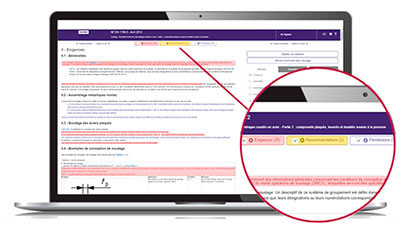
ZOOM ON ... the Requirements department
To comply with a standard, you need to quickly understand its issues in order to determine its impact on your activity.

The Requirements department helps you quickly locate within the normative text:
- mandatory clauses to satisfy,
- non-essential but useful clauses to know, such as permissions and recommendations.

The identification of these types of clauses is based on the document “ISO / IEC Directives, Part 2 - Principles and rules of structure and drafting of ISO documents ”as well as on a constantly enriched list of verbal forms.

With Requirements, quickly access the main part of the normative text!

With Requirements, quickly access the main part of the normative text!
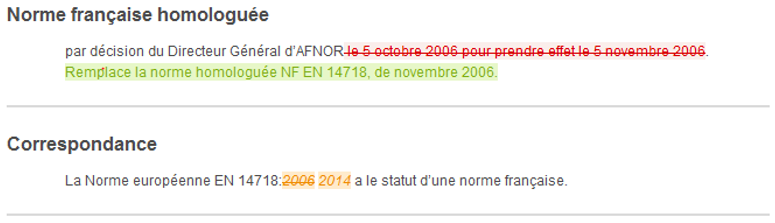
What is the Redline format?
The Redline + service - standards comparator allows you to easily and simply identify major changes between the current standard and its last canceled version.

At a glance, you will be able to identify the additions, deletions or modifications to a text, table, figure and formula.
At a glance, you will be able to identify the additions, deletions or modifications to a text, table, figure and formula

The Redlines + service is offered to you on the collection of French standards in force, in French language and in HTML and PDF format.

For an overview of the service, click on View a standard in redline format
Need to identify, monitor and decipher standards?

COBAZ is the simple and effective solution to meet the normative needs related to your activity, in France and abroad.

Available by subscription, CObaz is THE modular solution to compose according to your needs today and tomorrow. Quickly discover CObaz!

Request your free, no-obligation live demo

I discover COBAZ