ISO 3924:2019
ISO 3924:2019

ISO 3924:2019

July 2019
International standard Current

Petroleum products - Determination of boiling range distribution - Gas chromatography method

This document specifies a method for the determination of the boiling range distribution of petroleum products. The method is applicable to petroleum products and fractions with a final boiling point of 538 °C or lower at atmospheric pressure as determined by this document. This document does not apply to gasoline samples or gasoline components. The method is limited to products having a boiling range greater than 55 °C and having a vapour pressure sufficiently low to permit sampling at ambient temperature.The document describes two procedures.a) Procedure A allows a larger selection of columns and analysis conditions, such as packed and capillary columns as well as a thermal conductivity detector in addition to the flame ionization detector. Analysis times range from 14 min to 60 min.b) Procedure B is restricted to only three capillary columns and requires no sample dilution. The analysis time is reduced to about 8 min.Both procedures have been successfully applied to samples containing fatty acid methyl esters (FAME) up to 20 % (volume fraction).NOTE For the purposes of this document, the terms "% (mass fraction)" and "% (volume fraction)" are used to represent the mass fraction (µ), the volume fraction (φ) of a material.


View the extract
Main informations

Collections

International ISO standards

Publication date

July 2019

Number of pages

39 p.

Reference

ISO 3924:2019

ICS Codes

75.080   Petroleum products in general

Print number

1
Sumary
Petroleum products - Determination of boiling range distribution - Gas chromatography method

This document specifies a method for the determination of the boiling range distribution of petroleum products. The method is applicable to petroleum products and fractions with a final boiling point of 538 °C or lower at atmospheric pressure as determined by this document. This document does not apply to gasoline samples or gasoline components. The method is limited to products having a boiling range greater than 55 °C and having a vapour pressure sufficiently low to permit sampling at ambient temperature.

The document describes two procedures.

a) Procedure A allows a larger selection of columns and analysis conditions, such as packed and capillary columns as well as a thermal conductivity detector in addition to the flame ionization detector. Analysis times range from 14 min to 60 min.

b) Procedure B is restricted to only three capillary columns and requires no sample dilution. The analysis time is reduced to about 8 min.

Both procedures have been successfully applied to samples containing fatty acid methyl esters (FAME) up to 20 % (volume fraction).

NOTE For the purposes of this document, the terms "% (mass fraction)" and "% (volume fraction)" are used to represent the mass fraction (µ), the volume fraction (φ) of a material.
Replaced standards (1)
ISO 3924:2016
ISO 3924:2016
September 2016
International standard Cancelled
Petroleum products - Determination of boiling range distribution - Gas chromatography method

ISO 3924:2016 specifies a method for the determination of the boiling range distribution of petroleum products. The method is applicable to petroleum products and fractions with a final boiling point of 538 °C or lower at atmospheric pressure as determined by this International Standard. This International Standard is not applicable to gasoline samples or gasoline components. The method is limited to products having a boiling range greater than 55 °C and having a vapour pressure sufficiently low to permit sampling at ambient temperature. The method has successfully been applied to samples containing fatty acid methyl esters (FAME) up to 10 % (V/V).

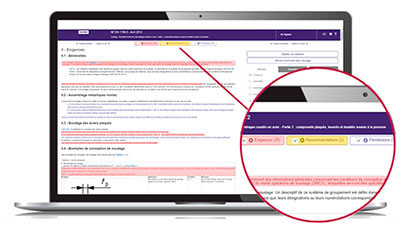
ZOOM ON ... the Requirements department

To comply with a standard, you need to quickly understand its issues in order to determine its impact on your activity.

The Requirements department helps you quickly locate within the normative text:

  • mandatory clauses to satisfy,
  • non-essential but useful clauses to know, such as permissions and recommendations.

The identification of these types of clauses is based on the document "ISO/IEC Directives, Part 2 - Principles and rules of structure and drafting of ISO documents" as well as on a constantly enriched list of verbal forms.

With Requirements, quickly access the main part of the normative text!


What is the Redline format?
Need to identify, monitor and decipher standards?