
ISO 6615:1993
ISO 6615:1993

ISO 6615:1993

September 1993
International standard Current

Petroleum products — Determination of carbon residue — Conradson method

The principle of the method specified is placing a weighed test portion in a crucible and subjecting to destructive distillation. The residue undergoes cracking and coking reactions during a fixed period of severe heating. At the end of the specified heat period, the test crucible containing the carbonaceous residue is cooled in a desiccator and weighed. The residue remaining is calculated as a mass percentage of the original test portion. The method may be used to determine amounts of carbon residues in the range of 0,01 % (m/m) to 30,0 % (m/m), left after evaporation and pyrolysis.

View the extract
Main informations

Collections

International ISO standards

Publication date

September 1993

Number of pages

11 p.

Reference

ISO 6615:1993

ICS Codes

75.080   Petroleum products in general

Print number

2
Sumary
Petroleum products — Determination of carbon residue — Conradson method

The principle of the method specified is placing a weighed test portion in a crucible and subjecting to destructive distillation. The residue undergoes cracking and coking reactions during a fixed period of severe heating. At the end of the specified heat period, the test crucible containing the carbonaceous residue is cooled in a desiccator and weighed. The residue remaining is calculated as a mass percentage of the original test portion. The method may be used to determine amounts of carbon residues in the range of 0,01 % (m/m) to 30,0 % (m/m), left after evaporation and pyrolysis.

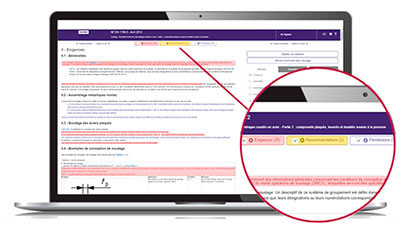
ZOOM ON ... the Requirements department

To comply with a standard, you need to quickly understand its issues in order to determine its impact on your activity.

The Requirements department helps you quickly locate within the normative text:

  • mandatory clauses to satisfy,
  • non-essential but useful clauses to know, such as permissions and recommendations.

The identification of these types of clauses is based on the document "ISO/IEC Directives, Part 2 - Principles and rules of structure and drafting of ISO documents" as well as on a constantly enriched list of verbal forms.

With Requirements, quickly access the main part of the normative text!


Need to identify, monitor and decipher standards?