ISO 8100-1:2026
Lifts for the transport of persons and goods — Part 1: Safety rules for the construction and installation of passenger and goods passenger lifts
This document specifies the safety rules for lifts permanently serving buildings and constructions and intended for the transport of persons or persons and goods. It applies to traction lifts, positive drive lifts and hydraulic lifts that:serve specific levels; andhave a rated speed exceeding 0,15 m/s; andhave an enclosed car; andmove along guide rails inclined not more than 15° to the vertical; and are indoor or weather-protected.This document also applies to the electrical equipment of these lifts including the lighting and socket outlets in the well.This document specifies safety rules related to:persons to be safeguarded:users, including passengers, maintenance and inspection personnel;persons at the landings and outside of the well, or any machinery space and pulley room, who can be affected by the lift.property to be safeguarded:loads in the car;components of the lift installation;building in which the lift is installed.This document does not specify additional requirements for:lifts serving buildings with requirements for seismic conditions;lifts serving buildings with requirements for accessibility;lifts exposed to vandalism;lifts which can be used for firefighting and evacuation purposes under firefighters control;lifts which can be used to support faster evacuation of persons with disabilities;the behaviour of the lift when the control system of the lift receives a recall signal(s) in the event of fire in a building.This document is not applicable to passenger and goods passenger lifts, which are installed before the date of its publication.
This document specifies the safety rules for lifts permanently serving buildings and constructions and intended for the transport of persons or persons and goods. It applies to traction lifts, positive drive lifts and hydraulic lifts that:
- serve specific levels; and
- have a rated speed exceeding 0,15 m/s; and
- have an enclosed car; and
- move along guide rails inclined not more than 15° to the vertical; and
- are indoor or weather-protected.
This document also applies to the electrical equipment of these lifts including the lighting and socket outlets in the well.
This document specifies safety rules related to:
- persons to be safeguarded:
- users, including passengers, maintenance and inspection personnel;
- persons at the landings and outside of the well, or any machinery space and pulley room, who can be affected by the lift.
- property to be safeguarded:
- loads in the car;
- components of the lift installation;
- building in which the lift is installed.
This document does not specify additional requirements for:
- lifts serving buildings with requirements for seismic conditions;
- lifts serving buildings with requirements for accessibility;
- lifts exposed to vandalism;
- lifts which can be used for firefighting and evacuation purposes under firefighters control;
- lifts which can be used to support faster evacuation of persons with disabilities;
- the behaviour of the lift when the control system of the lift receives a recall signal(s) in the event of fire in a building.
This document is not applicable to passenger and goods passenger lifts, which are installed before the date of its publication.
1.1 This document specifies the safety rules for permanently installed new passenger or goods passenger lifts, with traction, positive or hydraulic drive, serving defined landing levels, having a car designed for the transportation of persons or persons and goods, suspended by ropes, chains or jacks and moving between guide rails inclined not more than 15° to the vertical. 1.2 In addition to the requirements of this document, supplementary requirements need to be considered in special cases (use of lifts by persons with disabilities, in case of fire, potentially explosive atmosphere, extreme climate conditions, seismic conditions, transporting dangerous goods, etc.). 1.3 This document does not cover: a) lifts with: drive systems other than those stated in 1.1; rated speed less than or equal to 0,15 m/s; b) hydraulic lifts: with a rated speed exceeding 1 m/s; where the setting of the pressure relief valve (5.9.3.5.3) exceeds 50 MPa; c) new passenger or goods passenger lifts in existing buildings[1] where, in some circumstances due to limitations enforced by building constraints, some requirements of this document cannot be met and local requirements, e.g., EN 81-21 need to be considered; d) lifting appliances, such as paternosters, mine lifts, theatrical lifts, appliances with automatic caging, skips, lifts and hoists for building and public works sites, ships' hoists, platforms for exploration or drilling at sea, construction and maintenance appliances or lifts in wind turbines; e) important modifications (see Annex C) to a lift installed before this document is brought into application; f) safety during operations of transport, erection, repairs, and dismantling of lifts. However, this document can usefully be taken as a basis. Noise and vibrations are not dealt with in this document as they are not found at levels which could be considered harmful with regard to the safe use and maintenance of the lift (see also 0.4.2). 1.4 This document is not applicable to passenger and goods passenger lifts, which are installed before the date of its publication. [1] An existing building is a building which is used or was already used before the order for the lift was placed. A building whose internal structure is completely renewed is considered a new building.

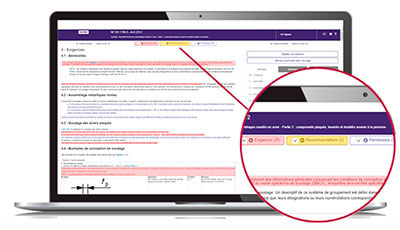
To comply with a standard, you need to quickly understand its issues in order to determine its impact on your activity.
The Requirements department helps you quickly locate within the normative text:
- mandatory clauses to satisfy,
- non-essential but useful clauses to know, such as permissions and recommendations.
The identification of these types of clauses is based on the document "ISO/IEC Directives, Part 2 - Principles and rules of structure and drafting of ISO documents" as well as on a constantly enriched list of verbal forms.
With Requirements, quickly access the main part of the normative text!

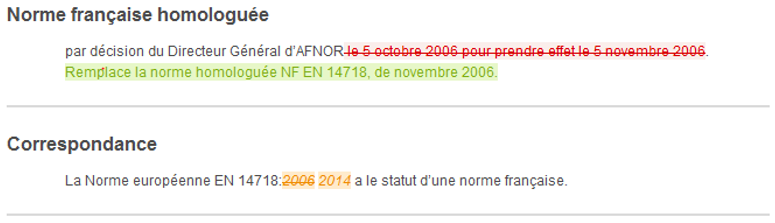
At a glance, you will be able to identify the additions, deletions or modifications to a text, table, figure and formula.

The Redlines + service is offered to you on the collection of French standards in force, in French language and in HTML and PDF format.
For an overview of the service, click on View a standard in redline format
COBAZ is the simple and effective solution to meet the normative needs related to your activity, in France and abroad.
Available by subscription, CObaz is THE modular solution to compose according to your needs today and tomorrow. Quickly discover CObaz!
Request your free, no-obligation live demo
I discover COBAZ