ISO/ASTM 52915:2020
ISO/ASTM 52915:2020

ISO/ASTM 52915:2020

April 2020
International standard Current

Specification for additive manufacturing file format (AMF) Version 1.2

This document provides the specification for the Additive Manufacturing File Format (AMF), an interchange format to address the current and future needs of additive manufacturing technology.This document specifies the requirements for the preparation, display and transmission for the AMF. When prepared in a structured electronic format, strict adherence to an extensible markup language (XML)[1] schema supports standards-compliant interoperability.NOTE A W3C XML schema definition (XSD) for the AMF is available from ISO from http://standards.iso.org/iso/52915 and from ASTM from www.astm.org/MEETINGS/images/amf.xsd. An implementation guide for such an XML schema is provided in Annex A.It is recognized that there is additional information relevant to the final part that is not covered by the current version of this document. Suggested future features are listed in Annex B.This document does not specify any explicit mechanisms for ensuring data integrity, electronic signatures and encryptions.


View the extract
Main informations

Collections

International ISO standards
ASTM american standards

Publication date

April 2020

Number of pages

27 p.

Reference

ISO/ASTM 52915:2020

ICS Codes

35.240.50   IT applications in industry
25.030   Additive manufacturing

Print number

3
Sumary
Specification for additive manufacturing file format (AMF) Version 1.2

This document provides the specification for the Additive Manufacturing File Format (AMF), an interchange format to address the current and future needs of additive manufacturing technology.

This document specifies the requirements for the preparation, display and transmission for the AMF. When prepared in a structured electronic format, strict adherence to an extensible markup language (XML)[1] schema supports standards-compliant interoperability.

NOTE A W3C XML schema definition (XSD) for the AMF is available from ISO from http://standards.iso.org/iso/52915 and from ASTM from www.astm.org/MEETINGS/images/amf.xsd. An implementation guide for such an XML schema is provided in Annex A.

It is recognized that there is additional information relevant to the final part that is not covered by the current version of this document. Suggested future features are listed in Annex B.

This document does not specify any explicit mechanisms for ensuring data integrity, electronic signatures and encryptions.
Replaced standards (1)
ISO/ASTM 52915:2016
ISO/ASTM 52915:2016
February 2016
International standard Cancelled
Specification for additive manufacturing file format (AMF) Version 1.2

ISO/ASTM 52915:2016 provides the specification for the Additive Manufacturing File Format (AMF), an interchange format to address the current and future needs of additive manufacturing technology. The AMF may be prepared, displayed and transmitted provided the requirements of this specification are met. When prepared in a structured electronic format, strict adherence to an extensible markup language (XML)[1] schema is required to support standards-compliant interoperability. A W3C XML schema definition (XSD) for the AMF is available from ISO from http://standards.iso.org/iso/52915 and from ASTM from www.astm.org/MEETINGS/images/amf.xsd. An implementation guide for such an XML schema is provided in Annex A. It is recognized that there is additional information relevant to the final part that is not covered by the current version of this International Standard. Suggested future features are listed in Annex B. ISO/ASTM 52915:2016 does not specify any explicit mechanisms for ensuring data integrity, electronic signatures and encryptions.

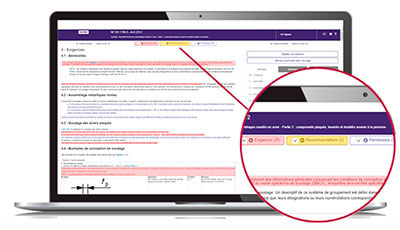
ZOOM ON ... the Requirements department

To comply with a standard, you need to quickly understand its issues in order to determine its impact on your activity.

The Requirements department helps you quickly locate within the normative text:

  • mandatory clauses to satisfy,
  • non-essential but useful clauses to know, such as permissions and recommendations.

The identification of these types of clauses is based on the document "ISO/IEC Directives, Part 2 - Principles and rules of structure and drafting of ISO documents" as well as on a constantly enriched list of verbal forms.

With Requirements, quickly access the main part of the normative text!


Need to identify, monitor and decipher standards?