
ISO/IEC 16500-5:1999

ISO/IEC 16500-5:1999

December 1999
International standard Current

Information technology — Generic digital audio-visual systems — Part 5: High and mid-layer protocols

This part of ISO/IEC 16500 covers the high and mid layer protocols for DAVIC systems. It defines a set ofprotocol components ("tools") which are referenced by ISO/IEC 16500-2 ("System Dynamics, Scenarios, andProtocol Requirements").In particular this part of ISO/IEC 16500 describes the protocol stacks required for the support of the DAVICflows, i.e., S1 through S5. The specific DAVIC options for each of the protocols are specified as well as thedifferent optional protocols stacks applicable. Requirements on protocols at specific interfaces are also consideredand included in the specification.

View the extract
Main informations

Collections

International ISO standards
International IEC standards

Publication date

December 1999

Number of pages

147 p.

Reference

ISO/IEC 16500-5:1999

ICS Codes

35.040.40   Coding of audio, video, multimedia and hypermedia information

Print number

1
Sumary
Information technology — Generic digital audio-visual systems — Part 5: High and mid-layer protocols

This part of ISO/IEC 16500 covers the high and mid layer protocols for DAVIC systems. It defines a set of

protocol components ("tools") which are referenced by ISO/IEC 16500-2 ("System Dynamics, Scenarios, and

Protocol Requirements").

In particular this part of ISO/IEC 16500 describes the protocol stacks required for the support of the DAVIC

flows, i.e., S1 through S5. The specific DAVIC options for each of the protocols are specified as well as the

different optional protocols stacks applicable. Requirements on protocols at specific interfaces are also considered

and included in the specification.

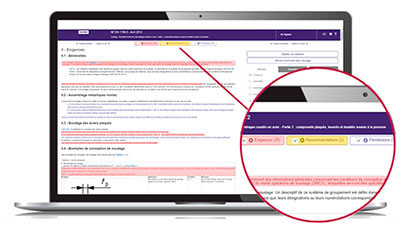
ZOOM ON ... the Requirements department

To comply with a standard, you need to quickly understand its issues in order to determine its impact on your activity.

The Requirements department helps you quickly locate within the normative text:

  • mandatory clauses to satisfy,
  • non-essential but useful clauses to know, such as permissions and recommendations.

The identification of these types of clauses is based on the document "ISO/IEC Directives, Part 2 - Principles and rules of structure and drafting of ISO documents" as well as on a constantly enriched list of verbal forms.

With Requirements, quickly access the main part of the normative text!


Need to identify, monitor and decipher standards?