

ISO/IEC 19509:2014
ISO/IEC 19509:2014

ISO/IEC 19509:2014

April 2014
International standard Current

Information technology ? Object Management Group XML Metadata Interchange (XMI)

ISO/IEC 19509:2014 supports the Meta Object Facility (MOF) Core defined in ISO/IEC 19508. MOF is the foundation technology for describing metamodels. It covers a wide range of domains, and is based on a constrained subset of UML. XMI is widely used XML interchange format. It defines the following aspects involved in describing objects in XML:the representation of objects in terms of XML elements and attributes;the standard mechanisms to link objects within the same file or across files;the validation of XMI documents using XML Schemas;object identity, which allows objects to be referenced from other objects in terms of IDs and UUIDs.XMI describes solutions to the above issues by specifying EBNF production rules to create XML documents and Schemas that share objects consistently.

View the extract
Main informations

Collections

International ISO standards
International IEC standards

Publication date

April 2014

Number of pages

105 p.

Reference

ISO/IEC 19509:2014

ICS Codes

35.040.50   Automatic identification and data capture techniques

Print number

1
Sumary
Information technology ? Object Management Group XML Metadata Interchange (XMI)

ISO/IEC 19509:2014 supports the Meta Object Facility (MOF) Core defined in ISO/IEC 19508. MOF is the foundation technology for describing metamodels. It covers a wide range of domains, and is based on a constrained subset of UML. XMI is widely used XML interchange format. It defines the following aspects involved in describing objects in XML:

  • the representation of objects in terms of XML elements and attributes;
  • the standard mechanisms to link objects within the same file or across files;
  • the validation of XMI documents using XML Schemas;
  • object identity, which allows objects to be referenced from other objects in terms of IDs and UUIDs.

XMI describes solutions to the above issues by specifying EBNF production rules to create XML documents and Schemas that share objects consistently.

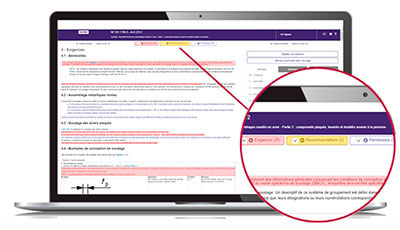
ZOOM ON ... the Requirements department

To comply with a standard, you need to quickly understand its issues in order to determine its impact on your activity.

The Requirements department helps you quickly locate within the normative text:

  • mandatory clauses to satisfy,
  • non-essential but useful clauses to know, such as permissions and recommendations.

The identification of these types of clauses is based on the document "ISO/IEC Directives, Part 2 - Principles and rules of structure and drafting of ISO documents" as well as on a constantly enriched list of verbal forms.

With Requirements, quickly access the main part of the normative text!


Need to identify, monitor and decipher standards?