ISO/IEC Guide 98-4:2012

ISO/IEC Guide 98-4:2012

November 2012
Guide Current

Uncertainty of measurement — Part 4: Role of measurement uncertainty in conformity assessment

ISO/IEC Guide 98-4:2012 provides guidance and procedures for assessing the conformity of an item (entity, object or system) with specified requirements. The item might be, for example, a gauge block, a grocery scale or a blood sample. The procedures can be applied where the following conditions exist: the item is distinguished by a single scalar quantity (a measurable property) defined to a level of detail sufficient to be reasonably represented by an essentially unique true value; an interval of permissible values of the property is specified by one or two tolerance limits; the property can be measured and the measurement result expressed in a manner consistent with the principles of the GUM, so that knowledge of the value of the property can be reasonably described by (a) a probability density function, (b) a distribution function, (c) numerical approximations to such functions, or (d) a best estimate, together with a coverage interval and an associated coverage probability.The procedures developed in this document can be used to realize an interval, called an acceptance interval, of permissible measured values of the property of interest. Acceptance limits can be chosen so as to balance the risks associated with accepting non-conforming items (consumer's risk) or rejecting conforming items (producer's risk).Two types of conformity assessment problems are addressed. The first is the setting of acceptance limits that will assure that a desired conformance probability for a single measured item is achieved. The second is the setting of acceptance limits to assure an acceptable level of confidence on average as a number of (nominally identical) items are measured. Guidance is given for their solution.This document contains examples to illustrate the guidance provided. The concepts presented can be extended to more general conformity assessment problems based on measurements of a set of scalar measurands. The audience of this document includes quality managers, members of standards development organizations, accreditation authorities and the staffs of testing and measuring laboratories, inspection bodies, certification bodies, regulatory agencies, academics and researchers.
View the extract
Main informations

Collections

International ISO standards
International IEC standards

Publication date

November 2012

Number of pages

49 p.

Reference

ISO/IEC Guide 98-4:2012

ICS Codes

17.020   Metrology and measurement in general

Print number

1
Sumary
Uncertainty of measurement — Part 4: Role of measurement uncertainty in conformity assessment

ISO/IEC Guide 98-4:2012 provides guidance and procedures for assessing the conformity of an item (entity, object or system) with specified requirements. The item might be, for example, a gauge block, a grocery scale or a blood sample. The procedures can be applied where the following conditions exist: the item is distinguished by a single scalar quantity (a measurable property) defined to a level of detail sufficient to be reasonably represented by an essentially unique true value; an interval of permissible values of the property is specified by one or two tolerance limits; the property can be measured and the measurement result expressed in a manner consistent with the principles of the GUM, so that knowledge of the value of the property can be reasonably described by (a) a probability density function, (b) a distribution function, (c) numerical approximations to such functions, or (d) a best estimate, together with a coverage interval and an associated coverage probability.

The procedures developed in this document can be used to realize an interval, called an acceptance interval, of permissible measured values of the property of interest. Acceptance limits can be chosen so as to balance the risks associated with accepting non-conforming items (consumer's risk) or rejecting conforming items (producer's risk).

Two types of conformity assessment problems are addressed. The first is the setting of acceptance limits that will assure that a desired conformance probability for a single measured item is achieved. The second is the setting of acceptance limits to assure an acceptable level of confidence on average as a number of (nominally identical) items are measured. Guidance is given for their solution.

This document contains examples to illustrate the guidance provided. The concepts presented can be extended to more general conformity assessment problems based on measurements of a set of scalar measurands. The audience of this document includes quality managers, members of standards development organizations, accreditation authorities and the staffs of testing and measuring laboratories, inspection bodies, certification bodies, regulatory agencies, academics and researchers.

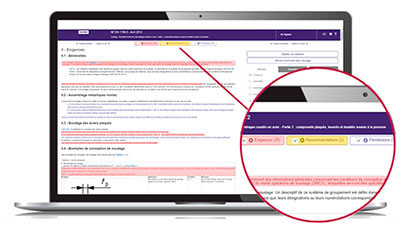
ZOOM ON ... the Requirements department
To comply with a standard, you need to quickly understand its issues in order to determine its impact on your activity.

The Requirements department helps you quickly locate within the normative text:
- mandatory clauses to satisfy,
- non-essential but useful clauses to know, such as permissions and recommendations.

The identification of these types of clauses is based on the document “ISO / IEC Directives, Part 2 - Principles and rules of structure and drafting of ISO documents ”as well as on a constantly enriched list of verbal forms.

With Requirements, quickly access the main part of the normative text!

With Requirements, quickly access the main part of the normative text!
Need to identify, monitor and decipher standards?

COBAZ is the simple and effective solution to meet the normative needs related to your activity, in France and abroad.

Available by subscription, CObaz is THE modular solution to compose according to your needs today and tomorrow. Quickly discover CObaz!

Request your free, no-obligation live demo

I discover COBAZ