ISO/TS 14064-4:2025
Greenhouse gases — Part 4: Guidance for the application of ISO 14064-1
This document describes the principles, concepts, and methods relating to the quantification and reporting of direct and indirect greenhouse gas (GHG) emissions for an organization. It gives guidance on the application of ISO 14064-1 to GHG inventory at the organization level, for the quantification and reporting of direct emissions and indirect emissions.This document describes for all organizations, the steps for:establishing organizational boundaries, in accordance with either a control approach (financial or operational) or an equity share approach;establishing reporting boundaries, by identifying direct and indirect emissions to be quantified and reported; for each category of emission, guidance is provided on specific boundaries and methodologies for the quantification of GHG emissions and removals;GHG reporting: the guidance is provided to promote transparency regarding the boundaries, the methodologies used for the quantification of direct and indirect GHG emissions and removals, and the uncertainty of the results.The examples and case studies presented in this document are not exclusive nor exhaustive. The values of the emission or removal factors mentioned in the examples are given for illustrative purposes only. A non-exhaustive list of database references is provided in Annex A.
This document describes the principles, concepts, and methods relating to the quantification and reporting of direct and indirect greenhouse gas (GHG) emissions for an organization. It gives guidance on the application of ISO 14064-1 to GHG inventory at the organization level, for the quantification and reporting of direct emissions and indirect emissions.
This document describes for all organizations, the steps for:
- establishing organizational boundaries, in accordance with either a control approach (financial or operational) or an equity share approach;
- establishing reporting boundaries, by identifying direct and indirect emissions to be quantified and reported; for each category of emission, guidance is provided on specific boundaries and methodologies for the quantification of GHG emissions and removals;
- GHG reporting: the guidance is provided to promote transparency regarding the boundaries, the methodologies used for the quantification of direct and indirect GHG emissions and removals, and the uncertainty of the results.
The examples and case studies presented in this document are not exclusive nor exhaustive. The values of the emission or removal factors mentioned in the examples are given for illustrative purposes only. A non-exhaustive list of database references is provided in Annex A.
ISO/TR 14069:2013 describes the principles, concepts and methods relating to the quantification and reporting of direct and indirect greenhouse gas (GHG) emissions for an organization. It provides guidance for the application of ISO 14064-1 to greenhouse gas inventories at the organization level, for the quantification and reporting of direct emissions, energy indirect emissions and other indirect emissions. ISO/TR 14069:2013 describes for all organizations, including local authorities, the steps for: establishing organizational boundaries, in accordance with either a control approach (financial or operational) or an equity share approach; establishing operational boundaries, by identifying direct emissions and energy indirect emissions to be quantified and reported, as well as any other indirect emissions the organization chooses to quantify and report; for each category of emission, guidance is provided on specific boundaries and methodologies for the quantification of GHG emissions and removals; GHG reporting: guidance is provided to promote transparency regarding the boundaries, the methodologies used for the quantification of direct and indirect GHG emissions and removals, and the uncertainty of the results.
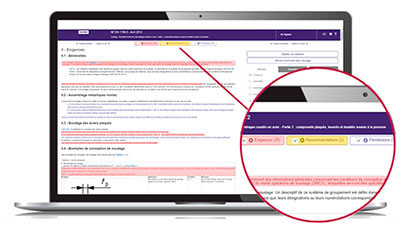
The Requirements department helps you quickly locate within the normative text:
- mandatory clauses to satisfy,
- non-essential but useful clauses to know, such as permissions and recommendations.
The identification of these types of clauses is based on the document “ISO / IEC Directives, Part 2 - Principles and rules of structure and drafting of ISO documents ”as well as on a constantly enriched list of verbal forms.
With Requirements, quickly access the main part of the normative text!

COBAZ is the simple and effective solution to meet the normative needs related to your activity, in France and abroad.
Available by subscription, CObaz is THE modular solution to compose according to your needs today and tomorrow. Quickly discover CObaz!
Request your free, no-obligation live demo
I discover COBAZ