ISO/TS 14521:2020
ISO/TS 14521:2020

ISO/TS 14521:2020

April 2020
Technical specification Current

Gears - Calculation of load capacity of worm gears

This document specifies formulae for calculating the load capacity of cylindrical worm gears and covers load ratings associated with wear, pitting, worm deflection, tooth breakage and temperature. Scuffing and other failure modes are not covered by this document.The load rating and design procedures are only valid for tooth surface sliding velocities, , less than or equal to 25 m/s and contact ratios greater than 2,1. For wear, load rating and design procedures are only valid for tooth surface sliding velocities which are above 0,1 m/s. The rules and recommendations for the dimensioning, lubricants or materials selected by this document only apply to centre distances of 50 mm and larger. For centre distances below 50 mm, method A applies.The choice of appropriate methods of calculation requires knowledge and experience. This document is intended for use by experienced gear designers who can make informed judgements concerning factors. It is not intended for use by engineers who lack the necessary experience. See 4.7.WARNING — The geometry of worm gears is complex, therefore the user of this document is encouraged to make sure that a valid working geometry has been established.


View the extract
Main informations

Collections

International ISO standards

Publication date

April 2020

Number of pages

88 p.

Reference

ISO/TS 14521:2020

ICS Codes

21.200   Gears

Print number

1
Sumary
Gears - Calculation of load capacity of worm gears

This document specifies formulae for calculating the load capacity of cylindrical worm gears and covers load ratings associated with wear, pitting, worm deflection, tooth breakage and temperature. Scuffing and other failure modes are not covered by this document.

The load rating and design procedures are only valid for tooth surface sliding velocities, , less than or equal to 25 m/s and contact ratios greater than 2,1. For wear, load rating and design procedures are only valid for tooth surface sliding velocities which are above 0,1 m/s. The rules and recommendations for the dimensioning, lubricants or materials selected by this document only apply to centre distances of 50 mm and larger. For centre distances below 50 mm, method A applies.

The choice of appropriate methods of calculation requires knowledge and experience. This document is intended for use by experienced gear designers who can make informed judgements concerning factors. It is not intended for use by engineers who lack the necessary experience. See 4.7.

WARNING — The geometry of worm gears is complex, therefore the user of this document is encouraged to make sure that a valid working geometry has been established.
Replaced standards (1)
ISO/TR 14521:2010
ISO/TR 14521:2010
November 2010
Technical report Cancelled
Gear - Calculation of load capacity of wormgears

ISO/TR 14521:2010 specifies equations for calculating the load capacity of cylindrical worm gears and covers load ratings associated with wear, pitting, worm deflection, tooth breakage and temperature. Scuffing and other failure modes are not covered by ISO/TR 14521:2010. The load rating and design procedures are valid for sliding velocities over tooth surfaces of up to 25 m/s and contact ratios equal to or greater than 2,1. For wear, sliding velocities over tooth surfaces are not below 0,1 m/s. The rules and recommendations for the dimensioning, lubricants or materials selected by ISO/TR 14521:2010 only apply to centre distances of 50 mm and larger. For centre distances below 50 mm, method A applies. The choice of appropriate methods of calculation requires knowledge and experience. ISO/TR 14521:2010 is intended for use by experienced gear designers who are able to make informed judgements concerning factors. It is not intended for use by engineers who lack the necessary experience. The geometry of worm gears is complex, therefore the user of ISO/TR 14521:2010 is encouraged to make sure that a valid working geometry has been established.

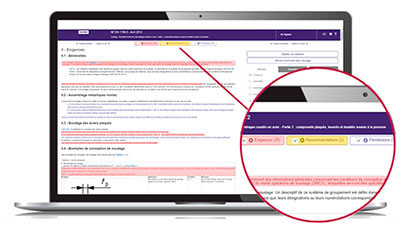
ZOOM ON ... the Requirements department

To comply with a standard, you need to quickly understand its issues in order to determine its impact on your activity.

The Requirements department helps you quickly locate within the normative text:

  • mandatory clauses to satisfy,
  • non-essential but useful clauses to know, such as permissions and recommendations.

The identification of these types of clauses is based on the document "ISO/IEC Directives, Part 2 - Principles and rules of structure and drafting of ISO documents" as well as on a constantly enriched list of verbal forms.

With Requirements, quickly access the main part of the normative text!


Need to identify, monitor and decipher standards?