ISO/TS 16175-2:2020
Information and documentation - Processes and functional requirements for software for managing records - Part 2: Guidance for selecting, designing, implementing and maintaining software for managing records
This document provides guidance for decision making and processes associated with the selection, design, implementation and maintenance of software for managing records, according to the principles specified in ISO 15489-1.This document is applicable to any kind of records system supported by software, including paper records managed by software, but is particularly focused on software for managing digital records.This document provides guidance to records professionals charged with, or supporting the selection, design, implementation and maintenance of systems for managing records using a variety of software. It can also provide assistance to information technology professionals such as solution architects/designers, IT procurement decision makers, business analysts, business owners and software developers and testers seeking to understand records requirements.
This document provides guidance for decision making and processes associated with the selection, design, implementation and maintenance of software for managing records, according to the principles specified in ISO 15489-1.
This document is applicable to any kind of records system supported by software, including paper records managed by software, but is particularly focused on software for managing digital records.
This document provides guidance to records professionals charged with, or supporting the selection, design, implementation and maintenance of systems for managing records using a variety of software. It can also provide assistance to information technology professionals such as solution architects/designers, IT procurement decision makers, business analysts, business owners and software developers and testers seeking to understand records requirements.
ISO 16175-2:2011 is applicable to products that are often termed "electronic records management systems" or "enterprise content management systems". ISO 16175-2:2011 uses the term digital records management systems for those software applications whose primary function is records management. It does not seek to set requirements for records still in use and held within business systems. Digital objects created by email, word processing, spreadsheet and imaging applications (such as text documents, and still or moving images), where they are identified to be of business value, are managed within digital records management systems which meet the functional requirements established in ISO 16175-2:2011. Records managed by a digital records management system can be stored on a variety of different media formats, and can be managed in hybrid record aggregations that include both digital and non-digital elements. ISO 16175-2:2011 does not attempt to include requirements that are not specific to, or necessary for, records management, for example, general system management and design requirements. Nor does it include requirements common to all software applications, such as performance, scalability and usability. Given the target audience of ISO 16175-2:2011, it also assumes a level of knowledge about developing design specifications, procurement and evaluation processes, and therefore these issues are not covered in ISO 16175-2:2011. Nonetheless, the importance of non-records management functional requirements for records management systems is recognized through their inclusion is given in the high-level model for structure and overview of functional requirements. ISO 16175-2:2011 does not give specifications for the long-term preservation of digital records; this issue needs to be addressed separately within a dedicated framework for digital preservation or "digital archiving" at the strategic level. These digital preservation considerations transcend the life of systems and are system independent; they need to be assessed in a specific migration and conversion plan at the tactical level. However, recognition of the need to maintain records for as long as they are required is addressed in ISO 16175-2:2011, and potential format obsolescence issues need to be considered when applying the functional requirements. ISO 16175-2:2011 articulates a set of functional requirements for digital records management systems. These requirements apply to records irrespective of the media in which they were created and/or stored. The requirements are intended to: define the processes and requirements for identifying and managing records in digital records management systems; define the records management functionality to be included in a design specification when building, upgrading or purchasing digital records management systems software; inform records management functional requirements in the selection of commercially available digital records management systems; and review the records management functionality of, or assess the compliance of, an existing digital records management system.
ISO 16175-3:2010 specifies general requirements and guidelines for records management and gives guidelines for the appropriate identification and management of evidence (records) of business activities transacted through business systems. It gives guidelines to understand processes and requirements for identifying and managing records in business systems; to develop requirements for functionality for records to be included in a design specification when building, upgrading or purchasing business system software; to evaluate the records management capability of proposed customized or commercial off-the-shelf business system software; to review the functionality for records or assess compliance of existing business systems. ISO 16175-3:2010 specifies requirements for export supports preservation by allowing the export of records to a system that is capable of long-term preservation activities, or for the ongoing migration of records into new systems. It does not specify requirements for the long-term preservation of digital records. ISO 16175-3:2010 is not applicable to records management in highly integrated software environments based on service-oriented architectures. ISO 16175-3:2010 does not specify a general system management, nor the design requirements such as usability, reporting, searching, system administration and performance. It also does not specify developing design specifications, procurement and evaluation processes in any detail.
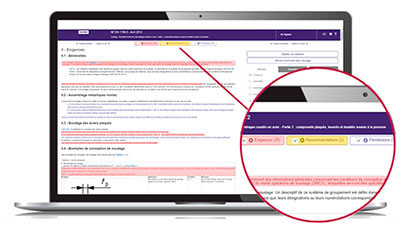
The Requirements department helps you quickly locate within the normative text:
- mandatory clauses to satisfy,
- non-essential but useful clauses to know, such as permissions and recommendations.
The identification of these types of clauses is based on the document “ISO / IEC Directives, Part 2 - Principles and rules of structure and drafting of ISO documents ”as well as on a constantly enriched list of verbal forms.
With Requirements, quickly access the main part of the normative text!

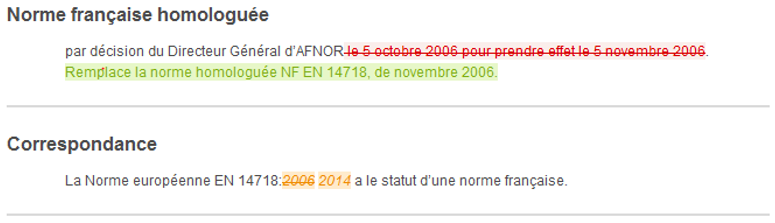
At a glance, you will be able to identify the additions, deletions or modifications to a text, table, figure and formula.

The Redlines + service is offered to you on the collection of French standards in force, in French language and in HTML and PDF format.
For an overview of the service, click on View a standard in redline format
COBAZ is the simple and effective solution to meet the normative needs related to your activity, in France and abroad.
Available by subscription, CObaz is THE modular solution to compose according to your needs today and tomorrow. Quickly discover CObaz!
Request your free, no-obligation live demo
I discover COBAZ