NF C93-850

NF C93-850

April 1988
Standard Cancelled

Generic specification for optical fibre cables.

Cette norme définit le domaine d'application, la terminologie, les méthodes de mesure relatives aux dimensions, aux caractéristiques mécaniques, optiques, et électriques et de transmission des câbles à fibres optiques.

Main informations

Collections

National standards and national normative documents

Publication date

April 1988

Number of pages

59 p.

Reference

NF C93-850

ICS Codes

33.180.10   Fibres and cables

Classification index

C93-850

Print number

1 - avril 1988
Sumary
Generic specification for optical fibre cables.

Cette norme définit le domaine d'application, la terminologie, les méthodes de mesure relatives aux dimensions, aux caractéristiques mécaniques, optiques, et électriques et de transmission des câbles à fibres optiques.
Replaced standards (1)
NF C93-850
March 1983
Standard Cancelled
Electronic components. Generic specification for optical fibres and cables.

Table of contents
  • SECTION UN - GENERALITES
  • 1.1 Domaine d'application
  • 1.2 Objet
  • 1.3 Documents de référence
  • 1.4 Terminologie
  • 1.5 Catégories de câbles à fibres optiques
  • 1.6 Matériaux
  • 1.7 Construction du câble
  • 1.8 Conditions normales d'essais
  • 1.9 Mesures optiques pendant les essais sur câble
  • SECTION DEUX - METHODES DE MESURE RELATIVES AUX DIMENSIONS
  • SECTION TROIS - METHODES DE MESURE RELATIVES AUX CARACTERISTIQUES MECANIQUES
  • 3.1 Objet
  • 3.2 Méthode NF C 93-850 E1 : Traction
  • 3.3 Méthode NF C 93-850 E2 : Abrasion
  • 3.4 Méthode NF C 93-850 E3 : Ecrasement
  • 3.5 Méthode NF C 93-850 E4 : Chocs
  • 3.6 Méthode NF C 93-850 E5 : Pression isostatique
  • 3.7 Méthode NF C 93-850 E6 : Pliages alternés
  • 3.8 Méthode NF C 93-850 E7 : Torsion
  • 3.9 Méthode NF C 93-850 E8 : Flexions alternées
  • 3.10 Méthode NF C 93-850 E9 : Tenue au crochetage
  • 3.11 Méthode NF C 93-850 E10 : Pliure
  • 3.12 Méthode NF C 93-850 E11 : Courbure statique
  • 3.13 Méthode NF C 93-850 E12 : Tenue au cisaillement
  • 3.14 Méthode NF C 93-850 E13 : Résistance aux impacts
  • 3.15 Méthode NF C 93-850 E14 : Rayon de courbure à la rupture
  • 3.16 Méthode NF C 93-850 E15 : Résistance au noeud
  • 3.17 Méthode NF C 93-850 E16 : Secousses
  • 3.18 Méthode NF C 93-850 E17 : Vibrations
  • 3.19 Méthode NF C 93-850 E18 : Essais de vibrations pour câbles aériens
  • SECTION QUATRE - METHODES DE MESURE RELATIVES AUX CARACTERISTIQUES OPTIQUES ET DE TRANSMISSION
  • SECTION CINQ - METHODES DE MESURE RELATIVES AUX CARACTERISTIQUES ELECTRIQUES
  • SECTION SIX - METHODES DE MESURE RELATIVES AUX CARACTERISTIQUES D'ENVIRONNEMENT
  • 6.1 Objet
  • 6.2 Méthode NF C 93-850 F1 : Cycles de température
  • 6.3 Méthode NF C 93-850 F2 : Contamination
  • 6.4 Méthode NF C 93-850 F3 : Intégrité de la gaine
  • 6.5 Méthode NF C 93-850 F4 : Pression statique externe
  • 6.6 Méthode NF C 93-850 F5 : Pénétration de l'eau
  • 6.7 Méthode NF C 93-850 F6 : Gel
  • 6.8 Méthode NF C 93-850 F7 : Rayonnements nucléaires
  • 6.9 Méthode NF C 93-850 F8 : Séquence climatique
  • 6.10 Méthode NF C 93-850 F9 : Variation rapide de température
  • 6.11 Méthode NF C 93-850 F10 : Chaleur sèche
  • 6.12 Méthode NF C 93-850 F11 : Chaleur humide (essai continu)
  • 6.13 Méthode NF C 93-850 F12 : Résistance des gainages à haute température
  • 6.14 Méthode NF C 93-850 F13 : Flexibilité à froid
  • 6.15 Méthode NF C 93-850 F14 : Fluage
  • 6.16 Méthode NF C 93-850 F15 : Basse pression atmosphérique
  • 6.17 Méthode NF C 93-850 415 F16 : Tenue diélectrique
  • 6.18 Méthode NF C 93-850 F17 : Tenue aux moisissures
  • 6.19 Méthode NF C 93-850 F18 : Immunité à l'éclairement extérieur
  • 6.20 Méthode NF C 93-850 F19 : Résistance au feu
ZOOM ON ... the Requirements department
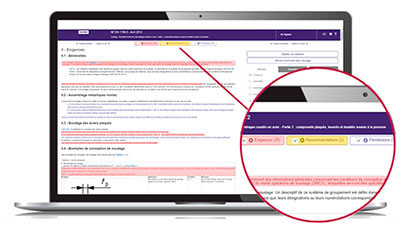
To comply with a standard, you need to quickly understand its issues in order to determine its impact on your activity.

The Requirements department helps you quickly locate within the normative text:
- mandatory clauses to satisfy,
- non-essential but useful clauses to know, such as permissions and recommendations.

The identification of these types of clauses is based on the document “ISO / IEC Directives, Part 2 - Principles and rules of structure and drafting of ISO documents ”as well as on a constantly enriched list of verbal forms.

With Requirements, quickly access the main part of the normative text!

With Requirements, quickly access the main part of the normative text!
Need to identify, monitor and decipher standards?

COBAZ is the simple and effective solution to meet the normative needs related to your activity, in France and abroad.

Available by subscription, CObaz is THE modular solution to compose according to your needs today and tomorrow. Quickly discover CObaz!

Request your free, no-obligation live demo

I discover COBAZ