

NF EN 15157
NF EN 15157

NF EN 15157

November 2006
Standard Cancelled

Advanced technical ceramics - Mechanical properties of ceramic composites at high temperature in air at atmospheric pressure - Determination of fatigue properties at constant amplitude

Le présent document spécifie les conditions de détermination des propriétés de fatigue cyclique à amplitude constante de contrainte ou de déformation en traction uniaxiale/traction ou en traction uniaxiale/compression des matériaux composites à matrice céramique (CMC) avec renfort des fibres pour une température jusqu'à 1 700 °C dans l'air à la pression atmosphérique.

Main informations

Collections

National standards and national normative documents

Publication date

November 2006

Number of pages

18 p.

Reference

NF EN 15157

ICS Codes

81.060.30   Advanced ceramics

Classification index

B43-356

Print number

1 - octobre 2006

European kinship

EN 15157:2006
Sumary
Advanced technical ceramics - Mechanical properties of ceramic composites at high temperature in air at atmospheric pressure - Determination of fatigue properties at constant amplitude

Le présent document spécifie les conditions de détermination des propriétés de fatigue cyclique à amplitude constante de contrainte ou de déformation en traction uniaxiale/traction ou en traction uniaxiale/compression des matériaux composites à matrice céramique (CMC) avec renfort des fibres pour une température jusqu'à 1 700 °C dans l'air à la pression atmosphérique.
Standard replaced by (1)
NF EN ISO 17142
NF EN ISO 17142
June 2016
Standard Current
Fine ceramics (advanced ceramics, advanced technical ceramics) - Mechanical properties of ceramic composites at high temperature in air at atmospheric pressure - Determination of fatigue properties at constant amplitude

ISO 17142:2014 specifies the conditions for the determination of properties at constant-amplitude of load or strain in uniaxial tension/tension or in uniaxial tension/compression cyclic fatigue of ceramic matrix composite materials (CMCs) with fibre reinforcement for temperature up to 1 700 °C in air at atmospheric pressure. It applies to all ceramic matrix composites with fibre reinforcement, unidirectional (1D), bi-directional (2D), and tri-directional (xD, where 2 < x ≤ 3). Its purpose is to determine the behaviour of CMC when subjected to mechanical fatigue and oxidation simultaneously. Tests for the determination of fatigue properties at high temperature in inert atmospheres differ from those in oxidative atmospheres. Contrary to an inert atmosphere, damage in an oxidative atmosphere accumulates due to the influence of purely mechanical fatigue and to chemical effects of the material's oxidation.

Table of contents
  • Avant-propos
    3
  • 1 Domaine d'application
    4
  • 2 Références normatives
    4
  • 3 Termes, définitions et symboles
    5
  • 4 Principe
    7
  • 5 Signification et usage
    8
  • 6 Appareillage
    9
  • 6.1 Machine d'essai de fatigue
    9
  • 6.2 Système d'application d'effort
    9
  • 6.3 Dispositif de chauffage
    9
  • 6.4 Extensomètre
    9
  • 6.5 Mesure des températures
    9
  • 6.6 Système d'enregistrement des données
    10
  • 6.7 Micromètres
    10
  • 7 Éprouvettes
    10
  • 8 Préparation des éprouvettes
    11
  • 8.1 Usinage et préparation
    11
  • 8.2 Nombre d'éprouvettes
    11
  • 9 Mode opératoire
    11
  • 9.1 Configuration d'essai : Considérations sur la température
    11
  • 9.2 Mesurage des dimensions des éprouvettes
    11
  • 9.3 Technique de l'essai
    12
  • 9.4 Validité de l'essai
    13
  • 10 Calcul des résultats
    13
  • 10.1 Durée de fonctionnement avant défaillance, tf
    13
  • 10.2 Paramètres d'endommagement
    13
  • 10.3 Propriétés résiduelles
    14
  • 11 Rapport d'essai
    15
  • Annexe A
    (informative) Évolution schématique de E 16
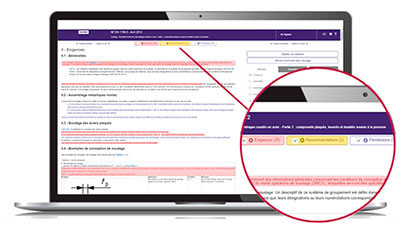
ZOOM ON ... the Requirements department
To comply with a standard, you need to quickly understand its issues in order to determine its impact on your activity.

The Requirements department helps you quickly locate within the normative text:
- mandatory clauses to satisfy,
- non-essential but useful clauses to know, such as permissions and recommendations.

The identification of these types of clauses is based on the document “ISO / IEC Directives, Part 2 - Principles and rules of structure and drafting of ISO documents ”as well as on a constantly enriched list of verbal forms.

With Requirements, quickly access the main part of the normative text!

With Requirements, quickly access the main part of the normative text!
New: UPSELL service
Need to identify, monitor and decipher standards?