NF EN 15410
Solid recovered fuels - Method for the determination of the content of major elements (Al, Ca, Fe, K, Mg, Na, P, Si, Ti)
Le présent document spécifie trois méthodes de digestion des combustibles solides de récupération : la digestion assistée par micro-ondes avec un mélange d'acides fluorhydrique, nitrique et chlorhydrique ; la digestion dans un bain d'eau chaude avec un mélange d'acides fluorhydrique, nitrique et chlorhydrique, après réduction à l'état de cendre de l'échantillon de combustibles solides de récupération ; la digestion dans un four avec un mélange d'acides nitrique, perchlorique et fluorhydrique.La détermination par des instruments du Si, de l'AI, du K, du Na, du Ca, du Mg, du Fe, du P et du Ti est effectuée par la spectrométrie avec plasma couplé par induction avec détection optique ou d'autres techniques spectroscopiques appropriées telles que la spectroscopie atomique à la flamme.
Le présent document spécifie trois méthodes de digestion des combustibles solides de récupération : la digestion assistée par micro-ondes avec un mélange d'acides fluorhydrique, nitrique et chlorhydrique ; la digestion dans un bain d'eau chaude avec un mélange d'acides fluorhydrique, nitrique et chlorhydrique, après réduction à l'état de cendre de l'échantillon de combustibles solides de récupération ; la digestion dans un four avec un mélange d'acides nitrique, perchlorique et fluorhydrique. La détermination par des instruments du Si, de l'AI, du K, du Na, du Ca, du Mg, du Fe, du P et du Ti est effectuée par la spectrométrie avec plasma couplé par induction avec détection optique ou d'autres techniques spectroscopiques appropriées telles que la spectroscopie atomique à la flamme.
This document specifies methods for the determination of major and minor element concentrations in solid recovered fuels after digestion by the use of different acid mixtures and by addition of a fluxing agent for solid recovered fuel (SRF) ash. a) Method A: Microwave assisted digestion with hydrochloric, nitric and hydrofluoric acid mixture (6 ml HCl; 2 ml HNO3; 2 ml HF) followed by boric acid complexation; b) Method AT: Microwave assisted digestion with hydrochloric, nitric and tetrafluoroboric acid mixture (6 ml HCl; 2 ml HNO3; 4 ml HBF4); c) Method B: Microwave assisted digestion with hydrochloric, nitric and hydrofluoric acid mixture (0,5 ml HCl; 6 ml HNO3; 1 ml HF) followed by boric acid complexation; d) Method BT: Microwave assisted digestion with hydrochloric, nitric and tetrafluoroboric acid mixture (0,5 ml HCl; 6 ml HNO3; 2 ml HBF4); e) Method C: Microwave assisted digestion with nitric acid, hydrogen peroxide and hydrofluoric acid mixture (2,5 ml H2O2; 5 ml HNO3; 0,4 ml HF) and optional boric acid complexation; f) Method CT: Microwave assisted digestion with nitric acid, hydrogen peroxide and tetrafluoroboric acid mixture (2,5 ml H2O2; 5 ml HNO3; 0,8 ml HBF4); g) Method D: Digestion of the ashed SRF sample with fluxing agent lithium metaborate in an oven at 1 050 °C. This document is applicable for the following major and minor/trace elements: ? Major elements: aluminium (Al), calcium (Ca), iron (Fe), potassium (K), magnesium (Mg), sodium (Na), phosphorus (P), sulfur (S), silicon (Si) and titanium (Ti). ? Minor/trace elements: arsenic (As), barium (Ba), beryllium (Be), cadmium (Cd), cobalt (Co), chromium (Cr), copper (Cu), mercury (Hg), molybdenum (Mo), manganese (Mn), nickel (Ni), lead (Pb), antimony (Sb), selenium (Se), tin (Sn), thallium (Tl), vanadium (V) and zinc (Zn). Method A is applicable for general use for SRF and ashed SRFs, but the amount of the test portion can be very low in case of high concentration of organic matter. Method AT can be used if an alternative to HF is necessary. Method B with a higher volume of nitric acid is applicable for SRFs with high organic matter (e.g. suitable for high plastic content) that can be difficult to digest with less nitric acid or as a substitute for method A if appropriate equipment is not available. Method BT can be used if an alternative to HF is necessary. Method C with combination of nitric acid and hydrogen peroxide and addition of hydrofluoric acid is applicable for wood based SRFs (e.g. demolition wood) or when there is a need for comparability to solid biofuel standards. Method CT can be used if an alternative to HF is necessary. Method D is specifically applicable for determination of major elements in ashed SRF samples. XRF can be used for the analysis of major elements (Al, Ca, Fe, K, Mg, Na, P, S, Si, Ti) after ashing (815 °C) of the samples and several major and minor/trace elements in SRF can be analysed by XRF after suitable calibration provided that the concentration levels are above instrumental detection limits of the XRF instrumentation and after proper preliminary testing and validation. Digestion methods with HF and subsequent boric acid complexation or application of method D are applicable for determination of Si and Ti (better digestion efficiency). Alternative digestion methods can be applied, if their performance is proved to be comparable with those of the methods described in this document.
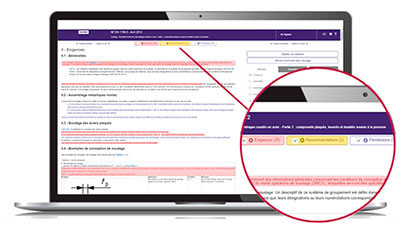
The Requirements department helps you quickly locate within the normative text:
- mandatory clauses to satisfy,
- non-essential but useful clauses to know, such as permissions and recommendations.
The identification of these types of clauses is based on the document “ISO / IEC Directives, Part 2 - Principles and rules of structure and drafting of ISO documents ”as well as on a constantly enriched list of verbal forms.
With Requirements, quickly access the main part of the normative text!

- With a single click, add a new language, the Requirements or Redline+ service and add one or more additional users.
- Whether you are in the process of acquiring a standard or it is already available in your personal space, the UPSELL service is available at every stage to help you understand it and implement it within your organization.
COBAZ is the simple and effective solution to meet the normative needs related to your activity, in France and abroad.
Available by subscription, CObaz is THE modular solution to compose according to your needs today and tomorrow. Quickly discover CObaz!
Request your free, no-obligation live demo
I discover COBAZ