NF EN 15411

NF EN 15411

December 2011
Standard Cancelled

Solid recovered fuels - Methods for the determination of the content of trace elements (As, Ba, Be, Cd, Co, Cr, Cu, Hg, Mo, Mn, Ni, Pb, Sb, Se, Tl, V and Zn)

Le présent document spécifie trois méthodes de digestion pour les combustibles solides de récupération : la digestion assistée par micro-ondes avec un mélange d'acides fluorhydrique, nitrique et chlorhydrique ; la digestion dans un bain d'eau chaude avec un mélange d'acides fluorhydrique, nitrique et chlorhydrique, après réduction à l'état de cendres de l'échantillon de combustibles solides de récupération (CSR) ; la digestion dans un four avec un mélange d'acides nitrique, perchlorique et fluorhydrique. La détermination instrumentale de l'As, du Ba, du Be, du Cd, du Cr, du Co, du Cu, du Pb, du Mn, du Mo, du Ni, du Sb, du Se, du TI, du V, du Zn est effectuée par plasma couplé par induction avec détection optique ou volumétrique ou par spectrométrie d'absorption atomique avec four en graphite. Le Hg ne peut être analysé qu'après le mode opératoire de digestion assisté par micro-ondes ou, autrement, il peut être analysé par une méthode d'analyse directe (analyseur de mercure avancé AMA pour un mesurage direct de la teneur en Hg).


Main informations

Collections

National standards and national normative documents

Publication date

December 2011

Number of pages

26 p.

Reference

NF EN 15411

ICS Codes

75.160.10   Solid fuels

Classification index

X34-225

Print number

1 - 17/11/2011

European kinship

EN 15411:2011
Sumary
Solid recovered fuels - Methods for the determination of the content of trace elements (As, Ba, Be, Cd, Co, Cr, Cu, Hg, Mo, Mn, Ni, Pb, Sb, Se, Tl, V and Zn)

Le présent document spécifie trois méthodes de digestion pour les combustibles solides de récupération : la digestion assistée par micro-ondes avec un mélange d'acides fluorhydrique, nitrique et chlorhydrique ; la digestion dans un bain d'eau chaude avec un mélange d'acides fluorhydrique, nitrique et chlorhydrique, après réduction à l'état de cendres de l'échantillon de combustibles solides de récupération (CSR) ; la digestion dans un four avec un mélange d'acides nitrique, perchlorique et fluorhydrique. La détermination instrumentale de l'As, du Ba, du Be, du Cd, du Cr, du Co, du Cu, du Pb, du Mn, du Mo, du Ni, du Sb, du Se, du TI, du V, du Zn est effectuée par plasma couplé par induction avec détection optique ou volumétrique ou par spectrométrie d'absorption atomique avec four en graphite. Le Hg ne peut être analysé qu'après le mode opératoire de digestion assisté par micro-ondes ou, autrement, il peut être analysé par une méthode d'analyse directe (analyseur de mercure avancé AMA pour un mesurage direct de la teneur en Hg).
Standard replaced by (1)
NF EN ISO 3884
April 2025
Standard Current
Solid recovered fuels - Methods for the determination of the content of elements (Al, Ca, Fe, K, Mg, Na, P, S, Si, Ti, As, Ba, Be, Cd, Co, Cr, Cu, Hg, Mo, Mn, Ni, Pb, Sb, Se, Sn, Tl, V, Zn)

This document specifies methods for the determination of major and minor element concentrations in solid recovered fuels after digestion by the use of different acid mixtures and by addition of a fluxing agent for solid recovered fuel (SRF) ash. a)       Method A: Microwave assisted digestion with hydrochloric, nitric and hydrofluoric acid mixture (6 ml HCl; 2 ml HNO3; 2 ml HF) followed by boric acid complexation; b)       Method AT: Microwave assisted digestion with hydrochloric, nitric and tetrafluoroboric acid mixture (6 ml HCl; 2 ml HNO3; 4 ml HBF4); c)        Method B: Microwave assisted digestion with hydrochloric, nitric and hydrofluoric acid mixture (0,5 ml HCl; 6 ml HNO3; 1 ml HF) followed by boric acid complexation; d)       Method BT: Microwave assisted digestion with hydrochloric, nitric and tetrafluoroboric acid mixture (0,5 ml HCl; 6 ml HNO3; 2 ml HBF4); e)       Method C: Microwave assisted digestion with nitric acid, hydrogen peroxide and hydrofluoric acid mixture (2,5 ml H2O2; 5 ml HNO3; 0,4 ml HF) and optional boric acid complexation; f)         Method CT: Microwave assisted digestion with nitric acid, hydrogen peroxide and tetrafluoroboric acid mixture (2,5 ml H2O2; 5 ml HNO3; 0,8 ml HBF4); g)       Method D: Digestion of the ashed SRF sample with fluxing agent lithium metaborate in an oven at 1 050 °C. This document is applicable for the following major and minor/trace elements: ?     Major elements: aluminium (Al), calcium (Ca), iron (Fe), potassium (K), magnesium (Mg), sodium (Na), phosphorus (P), sulfur (S), silicon (Si) and titanium (Ti). ?     Minor/trace elements: arsenic (As), barium (Ba), beryllium (Be), cadmium (Cd), cobalt (Co), chromium (Cr), copper (Cu), mercury (Hg), molybdenum (Mo), manganese (Mn), nickel (Ni), lead (Pb), antimony (Sb), selenium (Se), tin (Sn), thallium (Tl), vanadium (V) and zinc (Zn). Method A is applicable for general use for SRF and ashed SRFs, but the amount of the test portion can be very low in case of high concentration of organic matter. Method AT can be used if an alternative to HF is necessary. Method B with a higher volume of nitric acid is applicable for SRFs with high organic matter (e.g. suitable for high plastic content) that can be difficult to digest with less nitric acid or as a substitute for method A if appropriate equipment is not available. Method BT can be used if an alternative to HF is necessary. Method C with combination of nitric acid and hydrogen peroxide and addition of hydrofluoric acid is applicable for wood based SRFs (e.g. demolition wood) or when there is a need for comparability to solid biofuel standards. Method CT can be used if an alternative to HF is necessary. Method D is specifically applicable for determination of major elements in ashed SRF samples. XRF can be used for the analysis of major elements (Al, Ca, Fe, K, Mg, Na, P, S, Si, Ti) after ashing (815 °C) of the samples and several major and minor/trace elements in SRF can be analysed by XRF after suitable calibration provided that the concentration levels are above instrumental detection limits of the XRF instrumentation and after proper preliminary testing and validation. Digestion methods with HF and subsequent boric acid complexation or application of method D are applicable for determination of Si and Ti (better digestion efficiency). Alternative digestion methods can be applied, if their performance is proved to be comparable with those of the methods described in this document.

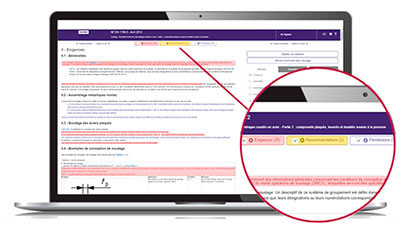
ZOOM ON ... the Requirements department
To comply with a standard, you need to quickly understand its issues in order to determine its impact on your activity.

The Requirements department helps you quickly locate within the normative text:
- mandatory clauses to satisfy,
- non-essential but useful clauses to know, such as permissions and recommendations.

The identification of these types of clauses is based on the document “ISO / IEC Directives, Part 2 - Principles and rules of structure and drafting of ISO documents ”as well as on a constantly enriched list of verbal forms.

With Requirements, quickly access the main part of the normative text!

With Requirements, quickly access the main part of the normative text!
New: UPSELL service
- The UPSELL service allows you to easily update one of your standards.
- With a single click, add a new language, the Requirements or Redline+ service and add one or more additional users.
- Whether you are in the process of acquiring a standard or it is already available in your personal space, the UPSELL service is available at every stage to help you understand it and implement it within your organization.
Need to identify, monitor and decipher standards?

COBAZ is the simple and effective solution to meet the normative needs related to your activity, in France and abroad.

Available by subscription, CObaz is THE modular solution to compose according to your needs today and tomorrow. Quickly discover CObaz!

Request your free, no-obligation live demo

I discover COBAZ