

NF EN 300093-1
NF EN 300093-1

NF EN 300093-1

April 2001
Standard Current

Integrated Services Digital Network (ISDN) - Calling Line Identification Restriction (CLIR) supplementary service - Digital Subscriber Signalling System No one (DSS1) protocol - Part 1 : protocol specification

Le présent document décrit le protocole de signalisation d'abonné numérique pour l'utilisation du complément de service "Non-identification de la ligne appelante(CLIR)", sur réseau numérique à intégration de services (RNIS).

Main informations

Collections

National standards and national normative documents

Publication date

April 2001

Number of pages

14 p.

Reference

NF EN 300093-1

ICS Codes

33.030   Telecommunication services. Applications
33.080   Integrated Services Digital Network (ISDN)

Classification index

Z82-093-1

Print number

1 - mars 2001

European kinship

EN 300093-1:1998
Sumary
Integrated Services Digital Network (ISDN) - Calling Line Identification Restriction (CLIR) supplementary service - Digital Subscriber Signalling System No one (DSS1) protocol - Part 1 : protocol specification

Le présent document décrit le protocole de signalisation d'abonné numérique pour l'utilisation du complément de service "Non-identification de la ligne appelante(CLIR)", sur réseau numérique à intégration de services (RNIS).
Replaced standards (1)
NF ETS 300093-1
NF ETS 300093-1
September 1994
Standard Cancelled
Integrated Services Digital Network (ISDN). Calling line identification restriction (clir) supplementary service. Digital subscriber signalling system number one (DSS1) protocol. Part 1 : protocol specification.

Le présent document décrit le protocole de signalisation d'abonné numérique pour l'utilisation du complément de service "Non-identification de la ligne appelante (CLIR)", sur réseau numérique à intégration de services (RNIS).

Table of contents
  • Droits de propriété intellectuelle
    3
  • Avant-propos
    3
  • 1 Domaine d'application
    4
  • 2 Références normatives
    4
  • 3 Définitions
    5
  • 4 Abréviations
    5
  • 5 Description
    5
  • 6 Prescriptions opérationnelles
    6
  • 6.1 Fourniture et retrait
    6
  • 6.2 Prescriptions pour le côté réseau d'origine
    6
  • 6.3 Prescriptions pour le réseau destinataire
    6
  • 7 Prescriptions relatives au codage
    6
  • 8 Définition des états
    6
  • 9 Procédures de signalisation au point de référence S et T coïncidents
    6
  • 9.1 Activation, désactivation et enregistrement
    6
  • 9.2 Délivrance du côté de l'origine de l'appel
    6
  • 9.3 Action au central local d'origine
    7
  • 9.4 Action au central local de destination
    7
  • 10 Procédures d'interfonctionnement avec les RNIS privés
    7
  • 11 Interaction avec d'autres réseaux
    7
  • 12 Interaction avec d'autres compléments de services
    7
  • 13 Valeurs de paramètres (temporisateurs)
    8
  • 14 Description dynamique (diagrammes LDS)
    8
  • Annexe A (informative) Flux de signalisation
    9
  • Annexe B (informative) Interchangeabilité des terminaux entre RNIS public et privé
    10
  • Annexe C (informative) Modifications par rapport à la précédente version de l'ETS 300 093-1
    11
  • Annexe D (informative) Bibliographie
    12
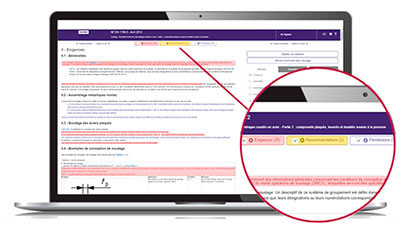
ZOOM ON ... the Requirements department

To comply with a standard, you need to quickly understand its issues in order to determine its impact on your activity.

The Requirements department helps you quickly locate within the normative text:

  • mandatory clauses to satisfy,
  • non-essential but useful clauses to know, such as permissions and recommendations.

The identification of these types of clauses is based on the document "ISO/IEC Directives, Part 2 - Principles and rules of structure and drafting of ISO documents" as well as on a constantly enriched list of verbal forms.

With Requirements, quickly access the main part of the normative text!


New: UPSELL service
Need to identify, monitor and decipher standards?