

NF EN 303978
NF EN 303978

NF EN 303978

March 2014
Standard Cancelled

Satellite Earth Stations and Systems (SES) - Harmonized EN for Earth Stations on Mobile Platforms (ESOMP) transmitting towards satellites in geostationary orbit in the 27,5 GHz to 30,0 GHz frequency bands covering the essential requirements of article 3.2 of the R&TTE Directive (V1.1.2)

Le présent document fait partie d''une série de normes développées par l''ETSI et est conçu pour s''intégrer dans une structure modulaire couvrant l''ensemble des équipements terminaux de radio et télécommunications relevant du domaine d''application de la Directive R et TTE. Le présent document s''applique aux stations terriennes sur plateformes mobiles (ESOMP).

Main informations

Collections

National standards and national normative documents

Publication date

March 2014

Number of pages

77 p.

Reference

NF EN 303978

ICS Codes

33.070.40   Satellite

Print number

1
Sumary
Satellite Earth Stations and Systems (SES) - Harmonized EN for Earth Stations on Mobile Platforms (ESOMP) transmitting towards satellites in geostationary orbit in the 27,5 GHz to 30,0 GHz frequency bands covering the essential requirements of article 3.2 of the R&TTE Directive (V1.1.2)

Le présent document fait partie d''une série de normes développées par l''ETSI et est conçu pour s''intégrer dans une structure modulaire couvrant l''ensemble des équipements terminaux de radio et télécommunications relevant du domaine d''application de la Directive R et TTE. Le présent document s''applique aux stations terriennes sur plateformes mobiles (ESOMP).
Standard replaced by (1)
NF EN 303978
NF EN 303978
April 2024
Standard Cancelled
Satellite Earth Stations and Systems (SES) - Harmonised Standard for Earth Stations on Mobile Platforms (ESOMP) transmitting towards satellites in geostationary orbit, operating in the 27,5 GHz to 30,0 GHz frequency bands covering the essential requirements of article 3.2 of the Directive 2014/53/EU (V2.1.2)

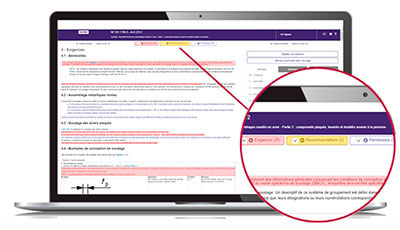
ZOOM ON ... the Requirements department

To comply with a standard, you need to quickly understand its issues in order to determine its impact on your activity.

The Requirements department helps you quickly locate within the normative text:

  • mandatory clauses to satisfy,
  • non-essential but useful clauses to know, such as permissions and recommendations.

The identification of these types of clauses is based on the document "ISO/IEC Directives, Part 2 - Principles and rules of structure and drafting of ISO documents" as well as on a constantly enriched list of verbal forms.

With Requirements, quickly access the main part of the normative text!


New: UPSELL service
Need to identify, monitor and decipher standards?