
NF EN 50306-2
NF EN 50306-2

NF EN 50306-2

March 2020
Standard Current

Railway applications - Railway rolling stock cables having special fire performance - Thin wall - Part 2 : single core cables

Le présent document définit les exigences constructives et dimensionnelles des câbles monoconducteurs, de tension assignée U 0 / U = 300 V/300 V, du type Non blindé (conducteur de 0,5 mm2 à 2,5 mm2) . Le présent document doit être utilisé conjointement avec la NF EN 50306-1, de mars 2020.

Main informations

Collections

National standards and national normative documents

Publication date

March 2020

Number of pages

21 p.

Reference

NF EN 50306-2

ICS Codes

29.060.20   Cables
45.040   Materials and components for railway engineering

Print number

1

European kinship

EN 50306-2:2020
Sumary
Railway applications - Railway rolling stock cables having special fire performance - Thin wall - Part 2 : single core cables

Le présent document définit les exigences constructives et dimensionnelles des câbles monoconducteurs, de tension assignée U 0 / U = 300 V/300 V, du type Non blindé (conducteur de 0,5 mm2 à 2,5 mm2) . Le présent document doit être utilisé conjointement avec la NF EN 50306-1, de mars 2020.
Replaced standards (1)
NF EN 50306-2
NF EN 50306-2
March 2003
Standard Cancelled
Railway applications - Railway rolling stock cables having special fire performance - Thin wall - Part 2 : single core cables

Le présent document définit les prescriptions et les dispositions constructives et dimensionnelles des conducteurs, de tension assignée 300 V entre âme et terre, du type suivant: Non blindé: conducteurs de 0,5 mm2 à 2,5 mm2. Le présent document peut être utilisé dans le cadre de l'attribution du droit d'usage de la Marque de conformité aux normes.

Table of contents
  • Avant-propos européen
  • 1 Domaine d'application
  • 2 Références normatives
  • 3 Termes et définitions
  • 4 Câbles monoconducteurs
  • 5 Essais
  • Bibliographie
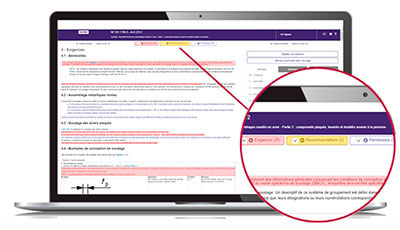
ZOOM ON ... the Requirements department

To comply with a standard, you need to quickly understand its issues in order to determine its impact on your activity.

The Requirements department helps you quickly locate within the normative text:

  • mandatory clauses to satisfy,
  • non-essential but useful clauses to know, such as permissions and recommendations.

The identification of these types of clauses is based on the document "ISO/IEC Directives, Part 2 - Principles and rules of structure and drafting of ISO documents" as well as on a constantly enriched list of verbal forms.

With Requirements, quickly access the main part of the normative text!


What is the Redline format?
New: UPSELL service
Need to identify, monitor and decipher standards?