

NF EN 675
NF EN 675

NF EN 675

December 1998
Standard Cancelled

Glass in building. Determination of thermal transmittance (U value). Heat flow meter method.

Le présent document spécifie la méthode du fluxmètre pour déterminer le coefficient de transmission thermique, U, de vitrages dont les faces sont planes et parallèles.

Main informations

Collections

National standards and national normative documents

Publication date

December 1998

Number of pages

15 p.

Reference

NF EN 675

ICS Codes

81.040.20   Glass in building

Classification index

P78-459

Print number

1 - octobre 2008

European kinship

EN 675:1997
Sumary
Glass in building. Determination of thermal transmittance (U value). Heat flow meter method.

Le présent document spécifie la méthode du fluxmètre pour déterminer le coefficient de transmission thermique, U, de vitrages dont les faces sont planes et parallèles.
Standard replaced by (1)
NF EN 675
NF EN 675
September 2011
Standard Current
Glass in building - Determination of thermal transmittance (U value) - Heat flow meter method

Le présent document spécifie une méthode de mesure visant à déterminer le coefficient de transmission thermique, U, de vitrages dont les faces sont planes et parallèles. Pour les besoins du présent document, les surfaces structurées peuvent être considérées comme planes.

Table of contents
  • Avant-propos
    3
  • 1 Domaine d'application
    4
  • 2 Références normatives
    4
  • 3 Définitions
    5
  • 4 Équations de base
    5
  • 5 Description succincte de la méthode de mesure
    5
  • 6 Appareillage
    5
  • 7 Calibrage de l'appareil de mesure
    6
  • 8 Dimensions des échantillons
    7
  • 9 Préparation des échantillons
    7
  • 10 Exécution des mesures
    7
  • 11 Évaluation des résultats
    7
  • 12 Expression des résultats
    8
  • 13 Rapport d'essai
    9
  • Annexe A (informative) Bibliographie
    12
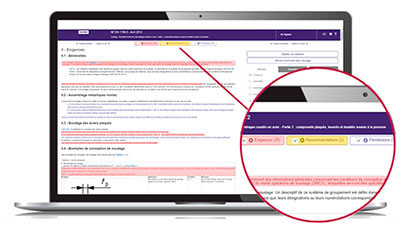
ZOOM ON ... the Requirements department
To comply with a standard, you need to quickly understand its issues in order to determine its impact on your activity.

The Requirements department helps you quickly locate within the normative text:
- mandatory clauses to satisfy,
- non-essential but useful clauses to know, such as permissions and recommendations.

The identification of these types of clauses is based on the document “ISO / IEC Directives, Part 2 - Principles and rules of structure and drafting of ISO documents ”as well as on a constantly enriched list of verbal forms.

With Requirements, quickly access the main part of the normative text!

With Requirements, quickly access the main part of the normative text!
New: UPSELL service
Need to identify, monitor and decipher standards?