NF EN ISO 10619-2
NF EN ISO 10619-2

NF EN ISO 10619-2

July 2021
Standard Current

Rubber and plastics hoses and tubing - Measurement of flexibility and stiffness - Part 2 : bending tests at sub-ambient temperatures

This document specifies two methods for measuring the stiffness and one method for the determination of the flexibility of rubber and plastics hoses and tubing when they are bent to a specific radius at sub-ambient temperatures.Method A is suitable for non-collapsible rubber and plastics hoses and tubing with a bore of up to and including 25 mm. This method provides a means of measuring the stiffness of the hose or tubing when the temperature is reduced from a standard laboratory temperature.Method B is suitable for rubber and plastics hoses and tubing with a bore of up to 100 mm and provides a means of assessing the flexibility of the hose or tubing when bent around a mandrel at a specified sub-ambient temperature. It can also be used as a routine quality control test.Method C is suitable for rubber and plastics hoses and tubing with a bore of 100 mm and greater. This method provides a means of measuring the stiffness of the hose and tubing at sub-ambient temperatures. This method is only suitable for hoses and tubing which are non-collapsible.


Main informations

Collections

National standards and national normative documents

Publication date

July 2021

Number of pages

18 p.

Reference

NF EN ISO 10619-2

ICS Codes

23.040.70   Hoses and hose assemblies

Classification index

T47-203-2

Print number

1

International kinship

ISO 10619-2:2021

European kinship

EN ISO 10619-2:2021
Sumary
Rubber and plastics hoses and tubing - Measurement of flexibility and stiffness - Part 2 : bending tests at sub-ambient temperatures

This document specifies two methods for measuring the stiffness and one method for the determination of the flexibility of rubber and plastics hoses and tubing when they are bent to a specific radius at sub-ambient temperatures.

Method A is suitable for non-collapsible rubber and plastics hoses and tubing with a bore of up to and including 25 mm. This method provides a means of measuring the stiffness of the hose or tubing when the temperature is reduced from a standard laboratory temperature.

Method B is suitable for rubber and plastics hoses and tubing with a bore of up to 100 mm and provides a means of assessing the flexibility of the hose or tubing when bent around a mandrel at a specified sub-ambient temperature. It can also be used as a routine quality control test.

Method C is suitable for rubber and plastics hoses and tubing with a bore of 100 mm and greater. This method provides a means of measuring the stiffness of the hose and tubing at sub-ambient temperatures. This method is only suitable for hoses and tubing which are non-collapsible.
Replaced standards (1)
NF EN ISO 10619-2
NF EN ISO 10619-2
February 2018
Standard Cancelled
Rubber and plastics hoses and tubing — Measurement of flexibility and stiffness — Part 2: Bending tests at sub-ambient temperatures

Table of contents
  • Avant-propos
  • 1 Domaine d'application
  • 2 Références normatives
  • 3 Termes et définitions
  • 4 Méthode A
  • 5 Méthode B
  • 6 Méthode C
ZOOM ON ... the Requirements department
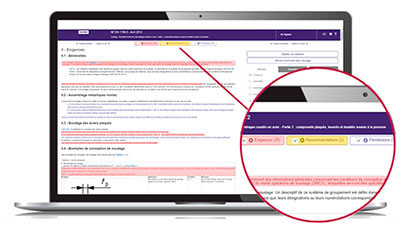
To comply with a standard, you need to quickly understand its issues in order to determine its impact on your activity.

The Requirements department helps you quickly locate within the normative text:
- mandatory clauses to satisfy,
- non-essential but useful clauses to know, such as permissions and recommendations.

The identification of these types of clauses is based on the document “ISO / IEC Directives, Part 2 - Principles and rules of structure and drafting of ISO documents ”as well as on a constantly enriched list of verbal forms.

With Requirements, quickly access the main part of the normative text!

With Requirements, quickly access the main part of the normative text!
What is the Redline format?
New: UPSELL service
Need to identify, monitor and decipher standards?