
NF EN ISO 10675-1
NF EN ISO 10675-1

NF EN ISO 10675-1

December 2021
Standard Current

Non-destructive testing of welds - Acceptance levels for radiographic testing - Part 1 : steel, nickel, titanium and their alloys

This document specifies acceptance levels for indications from imperfections in butt welds of steel, nickel, titanium and their alloys detected by radiographic testing. If agreed, the acceptance levels can be applied to other types of welds (such as fillet welds, etc.) or materials.The acceptance levels can be related to welding standards, application standards, specifications or codes. This document assumes that the radiographic testing has been carried out in accordance with ISO 17636‑1 for RT-F (F = film) or ISO 17636‑2 for RT-S (S = radioscopy) and RT-D (D = digital detectors).

Main informations

Collections

National standards and national normative documents

Publication date

December 2021

Number of pages

22 p.

Reference

NF EN ISO 10675-1

ICS Codes

25.160.40   Welded joints and welds

Classification index

A89-511-1

Print number

1

International kinship

ISO 10675-1:2021

European kinship

EN ISO 10675-1:2021
Sumary
Non-destructive testing of welds - Acceptance levels for radiographic testing - Part 1 : steel, nickel, titanium and their alloys

This document specifies acceptance levels for indications from imperfections in butt welds of steel, nickel, titanium and their alloys detected by radiographic testing. If agreed, the acceptance levels can be applied to other types of welds (such as fillet welds, etc.) or materials.

The acceptance levels can be related to welding standards, application standards, specifications or codes. This document assumes that the radiographic testing has been carried out in accordance with ISO 17636‑1 for RT-F (F = film) or ISO 17636‑2 for RT-S (S = radioscopy) and RT-D (D = digital detectors).

Replaced standards (1)
NF EN ISO 10675-1
NF EN ISO 10675-1
April 2017
Standard Cancelled
Non-destructive testing of welds — Acceptance levels for radiographic testing — Part 1: Steel, nickel, titanium and their alloys

Table of contents
  • Avant-propos
  • 1 Domaine d'application
  • 2 Références normatives
  • 3 Termes et définitions
  • 4 Symboles et abréviations
  • 5 Technique radiographique
  • 6 Généralités
  • 7 Niveaux d'acceptation
  • Annexe A (informative) Lignes directrices pour les limites des contrôles par radiographie
  • Annexe B (informative) Exemples de détermination du pourcentage ( pour cent ) de défauts
  • Annexe C (informative) Calcul de la somme des surfaces acceptables
  • Bibliographie
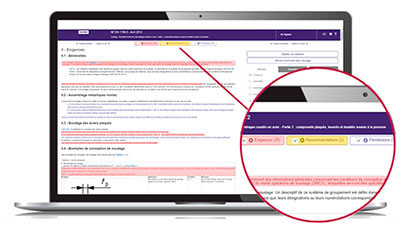
ZOOM ON ... the Requirements department
To comply with a standard, you need to quickly understand its issues in order to determine its impact on your activity.

The Requirements department helps you quickly locate within the normative text:
- mandatory clauses to satisfy,
- non-essential but useful clauses to know, such as permissions and recommendations.

The identification of these types of clauses is based on the document “ISO / IEC Directives, Part 2 - Principles and rules of structure and drafting of ISO documents ”as well as on a constantly enriched list of verbal forms.

With Requirements, quickly access the main part of the normative text!

With Requirements, quickly access the main part of the normative text!
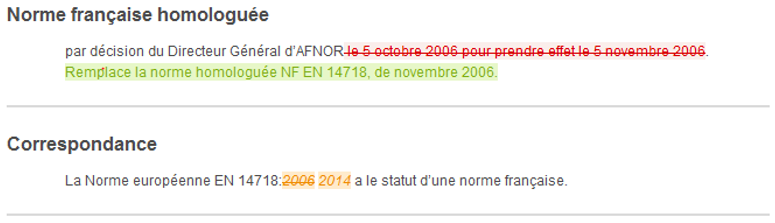
What is the Redline format?
New: UPSELL service
Need to identify, monitor and decipher standards?