
NF EN ISO 12855

NF EN ISO 12855

May 2013
Standard Cancelled

Electronic fee collection - Information exchange between service provision and toll charging

ISO 12855:2011 specifiesthe interfaces between electronic fee collection (EFC) systems for vehicle related transport services, e.g. road user charging, parking and access control; it does not cover interfaces for EFC systems for public transport; an EFC system can include any EFC system, e.g. also systems automatically reading licence plate numbers of vehicles passing a toll point;an exchange of information between the central equipment of the two roles of service provision and toll charging, e.g.charging related data (toll declarations, billing details),administrative data, andconfirmation data;transfer mechanisms and supporting functions;information objects, data syntax and semantics;examples of data interchanges.ISO 12855:2011 supports any toll service and any technology used for charging.It is defined as a toolbox standard of transactions and messages which can be used for the assigned purpose. The detailed definitions of mandatory and optional elements in a real implementation are defined elsewhere. It does not define all communication sequences, communication stacks and timings.

Main informations

Collections

National standards and national normative documents

Publication date

May 2013

Number of pages

91 p.

Reference

NF EN ISO 12855

ICS Codes

03.220.20   Road transport
35.240.60   IT applications in transport

Classification index

P99-413

Print number

1 - 24/04/2013

International kinship

European kinship

EN ISO 12855:2012
Sumary
Electronic fee collection - Information exchange between service provision and toll charging

ISO 12855:2011 specifies

  • the interfaces between electronic fee collection (EFC) systems for vehicle related transport services, e.g. road user charging, parking and access control; it does not cover interfaces for EFC systems for public transport; an EFC system can include any EFC system, e.g. also systems automatically reading licence plate numbers of vehicles passing a toll point;
  • an exchange of information between the central equipment of the two roles of service provision and toll charging, e.g.
    • charging related data (toll declarations, billing details),
    • administrative data, and
    • confirmation data;
  • transfer mechanisms and supporting functions;
  • information objects, data syntax and semantics;
  • examples of data interchanges.

ISO 12855:2011 supports any toll service and any technology used for charging.

It is defined as a toolbox standard of transactions and messages which can be used for the assigned purpose. The detailed definitions of mandatory and optional elements in a real implementation are defined elsewhere. It does not define all communication sequences, communication stacks and timings.

Standard replaced by (1)
NF EN ISO 12855
March 2016
Standard Cancelled
Electronic fee collection - Information exchange between service provision and toll charging

ISO 12855:2015 specifies - the interfaces between electronic fee collection (EFC) systems for vehicle related transport services, e.g. road user charging, parking and access control; it does not cover interfaces for EFC systems for public transport; an EFC system can include any EFC system, e.g. including systems that automatically read licence plate numbers of vehicles passing a toll point, - an exchange of information between the central equipment of the two roles of service provision and toll charging, e.g. - charging related data (toll declarations, billing details), - administrative data, and - confirmation data, - transfer mechanisms and supporting functions, - information objects, data syntax and semantics, - examples of data interchanges (see Annex C and Annex D), and - an example on how to use this International Standard for the European Electronic Tolling Service (EETS) (see Annex F). ISO 12855:2015 is applicable for any toll service and any technology used for charging. It is defined as a toolbox standard of transactions and Application Protocol Data Units (APDUs), which can be used for the assigned purpose. The detailed definitions of mandatory and optional elements in a real implementation are defined elsewhere. It does not define all communication sequences, communication stacks and timings. The scope of ISO 12855:2015 is illustrated in Figure 2. The data types and associated coding related to the data elements described in Clause 6 are defined in Annex A, using the abstract syntax notation one (ASN.1) according to ISO/IEC 8824‑1.

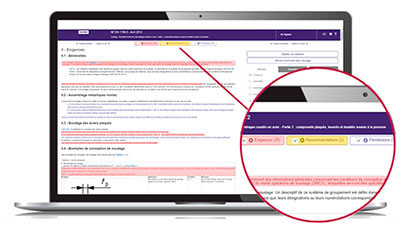
ZOOM ON ... the Requirements department
To comply with a standard, you need to quickly understand its issues in order to determine its impact on your activity.

The Requirements department helps you quickly locate within the normative text:
- mandatory clauses to satisfy,
- non-essential but useful clauses to know, such as permissions and recommendations.

The identification of these types of clauses is based on the document “ISO / IEC Directives, Part 2 - Principles and rules of structure and drafting of ISO documents ”as well as on a constantly enriched list of verbal forms.

With Requirements, quickly access the main part of the normative text!

With Requirements, quickly access the main part of the normative text!
New: UPSELL service
- The UPSELL service allows you to easily update one of your standards.
- With a single click, add a new language, the Requirements or Redline+ service and add one or more additional users.
- Whether you are in the process of acquiring a standard or it is already available in your personal space, the UPSELL service is available at every stage to help you understand it and implement it within your organization.
Need to identify, monitor and decipher standards?

COBAZ is the simple and effective solution to meet the normative needs related to your activity, in France and abroad.

Available by subscription, CObaz is THE modular solution to compose according to your needs today and tomorrow. Quickly discover CObaz!

Request your free, no-obligation live demo

I discover COBAZ