

NF EN ISO 13260
NF EN ISO 13260

NF EN ISO 13260

November 2011
Standard Current

Thermoplastics piping systems for non-pressure underground drainage and sewerage - Test method for resistance to combined temperature cycling and external loading

ISO 13260:2010 specifies two methods for testing pipes and fittings or joints for plastics piping systems intended for use in underground drainage and sewerage systems for their resistance to deformation and leakage, when subjected to sustained external loading in conjunction with the passage of hot water.

Main informations

Collections

National standards and national normative documents

Publication date

November 2011

Number of pages

18 p.

Reference

NF EN ISO 13260

ICS Codes

23.040.05   Pipelines and its parts for external sewage systems
23.040.20   Plastics pipes
91.140.80   Drainage systems
93.030   External sewage systems

Classification index

P16-360

Print number

1 - novembre 2011

International kinship

ISO 13260:2010

European kinship

EN ISO 13260:2011
Sumary
Thermoplastics piping systems for non-pressure underground drainage and sewerage - Test method for resistance to combined temperature cycling and external loading

ISO 13260:2010 specifies two methods for testing pipes and fittings or joints for plastics piping systems intended for use in underground drainage and sewerage systems for their resistance to deformation and leakage, when subjected to sustained external loading in conjunction with the passage of hot water.

Replaced standards (1)
NF EN 1437
NF EN 1437
December 2002
Standard Cancelled
Plastics piping systems - Piping systems for underground drainage and sewerage - Test method for resistance to combined temperature cycling and external loading

Le présent document spécifie deux méthodes d'essai de tubes et de raccords ou d'assemblages de systèmes de canalisations en matières plastiques pour assainissement enterré pour vérifier leur résistance à la déformation et aux fuites lorsqu'ils sont soumis à une charge extérieure permanente conjuguée avec le passage d'eau chaude. La méthode A, qui indique un cycle thermique, avec passage alterné d'eau chaude et d'eau froide, est applicable aux tubes et raccords associés de diamètre extérieur moyen dem inférieur ou égal à 190 mm. La méthode B, qui implique le seul passage d'eau chaude, sauf dans des intervalles spécifiés pour le mesurage de la déformation interne, est applicable aux tubes et raccords associés de diamètre extérieur moyen 190 mm < dem inférieur ou égal à 510 mm.

Table of contents
  • Avant-propos
    iv
  • 1 Domaine d'application
    1
  • 2 Références normatives
    1
  • 3 Principe
    1
  • 4 Appareillage
    2
  • 5 Éprouvette
    6
  • 6 Conditionnement
    7
  • 7 Mode opératoire
    7
  • 7.1 Mise en place de l'éprouvette et remplissage
    7
  • 7.2 Exposition à l'eau chaude
    8
  • 7.3 Évaluation
    9
  • 8 Calcul et expression des résultats
    10
  • 9 Rapport d'essai
    10
  • Annexe A (informative) Exigences recommandées
    12
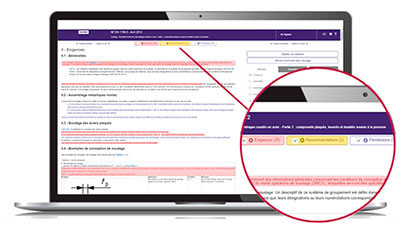
ZOOM ON ... the Requirements department

To comply with a standard, you need to quickly understand its issues in order to determine its impact on your activity.

The Requirements department helps you quickly locate within the normative text:

  • mandatory clauses to satisfy,
  • non-essential but useful clauses to know, such as permissions and recommendations.

The identification of these types of clauses is based on the document "ISO/IEC Directives, Part 2 - Principles and rules of structure and drafting of ISO documents" as well as on a constantly enriched list of verbal forms.

With Requirements, quickly access the main part of the normative text!


New: UPSELL service
Need to identify, monitor and decipher standards?