NF EN ISO 13588
NF EN ISO 13588

NF EN ISO 13588

March 2019
Standard Current

Non-destructive testing of welds - Ultrasonic testing - Use of automated phased array technology

This document specifies the application of the phased array technology for the semi- or fully automated ultrasonic testing of fusion-welded joints in metallic materials of minimum thickness 6 mm. It applies to full penetration welded joints of simple geometry in plates, pipes, and vessels, where both the weld and the parent material are low-alloy and/or fine grained steel. For the testing of welds in other steel materials this document gives guidance. For coarse-grained or austenitic steels, ISO 22825 applies in addition to this document.This document provides guidance on the specific capabilities and limitations of the phased array technology for the detection, location, sizing and characterization of discontinuities in fusion-welded joints. Phased array technology can be used as a stand-alone technology or in combination with other non-destructive testing (NDT) methods or techniques, for manufacturing inspection, pre-service and for in-service inspection.This document specifies four testing levels, each corresponding to a different probability of detection of imperfections.This document permits assessment of discontinuities for acceptance purposes based either on amplitude (equivalent reflector size) and length, or on height and length.This document does not include acceptance levels for discontinuities.This document is not applicable for automated testing of welds during the production of steel products covered by ISO 10893-8, ISO 10893-11 and ISO 3183.


Main informations

Collections

National standards and national normative documents

Publication date

March 2019

Number of pages

35 p.

Reference

NF EN ISO 13588

ICS Codes

25.160.40   Welded joints and welds

Classification index

A89-512

Print number

1

International kinship

ISO 13588:2019

European kinship

EN ISO 13588:2019
Sumary
Non-destructive testing of welds - Ultrasonic testing - Use of automated phased array technology

This document specifies the application of the phased array technology for the semi- or fully automated ultrasonic testing of fusion-welded joints in metallic materials of minimum thickness 6 mm. It applies to full penetration welded joints of simple geometry in plates, pipes, and vessels, where both the weld and the parent material are low-alloy and/or fine grained steel. For the testing of welds in other steel materials this document gives guidance. For coarse-grained or austenitic steels, ISO 22825 applies in addition to this document.

This document provides guidance on the specific capabilities and limitations of the phased array technology for the detection, location, sizing and characterization of discontinuities in fusion-welded joints. Phased array technology can be used as a stand-alone technology or in combination with other non-destructive testing (NDT) methods or techniques, for manufacturing inspection, pre-service and for in-service inspection.

This document specifies four testing levels, each corresponding to a different probability of detection of imperfections.

This document permits assessment of discontinuities for acceptance purposes based either on amplitude (equivalent reflector size) and length, or on height and length.

This document does not include acceptance levels for discontinuities.

This document is not applicable for automated testing of welds during the production of steel products covered by ISO 10893-8, ISO 10893-11 and ISO 3183.
Replaced standards (1)
NF EN ISO 13588
NF EN ISO 13588
November 2012
Standard Cancelled
Non-destructive testing of welds - Ultrasonic testing - Use of automated phased array technology

Table of contents
  • Avant-propos
  • 1 Domaine d'application
  • 2 Références normatives
  • 3 Termes et définitions
  • 4 Niveaux de contrôle
  • 5 Informations exigées avant le contrôle
  • 6 Exigences relatives au personnel et à l'appareillage d'essai
  • 7 Préparation avant contrôle
  • 8 Contrôle du métal de base
  • 9 Réglages de la gamme d'épaisseur et de la sensibilité
  • 10 Vérifications de l'appareillage
  • 11 Qualification du mode opératoire
  • 12 Contrôle des assemblages soudés
  • 13 Stockage des données
  • 14 Interprétation et analyse des données du multi-éléments
  • 15 Rapport de contrôle
  • Annexe A (informative) Blocs de référence et réflecteurs de référence types
  • Annexe B (informative) Illustrations des signaux diffractés possibles à utiliser
  • Bibliographie
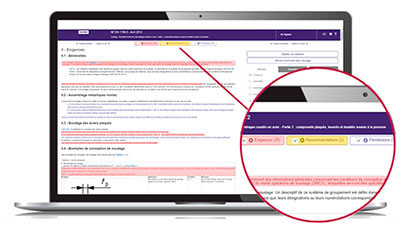
ZOOM ON ... the Requirements department
To comply with a standard, you need to quickly understand its issues in order to determine its impact on your activity.

The Requirements department helps you quickly locate within the normative text:
- mandatory clauses to satisfy,
- non-essential but useful clauses to know, such as permissions and recommendations.

The identification of these types of clauses is based on the document “ISO / IEC Directives, Part 2 - Principles and rules of structure and drafting of ISO documents ”as well as on a constantly enriched list of verbal forms.

With Requirements, quickly access the main part of the normative text!

With Requirements, quickly access the main part of the normative text!
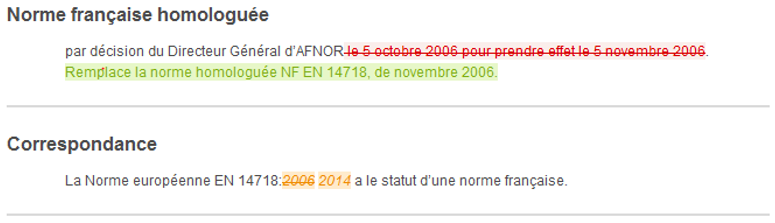
What is the Redline format?
New: UPSELL service
Need to identify, monitor and decipher standards?