

NF EN ISO 140-5
NF EN ISO 140-5

NF EN ISO 140-5

December 1998
Standard Cancelled

Acoustics. Measurement of sound insulation in buildings and of building elements. Part 5 : field measurements of airborne sound insulation of facade elements and facades.

Main informations

Collections

National standards and national normative documents

Publication date

December 1998

Number of pages

31 p.

Reference

NF EN ISO 140-5

ICS Codes

17.140.01   Acoustic measurements and noise abatement in general
91.120.20   Acoustics in building. Sound insulation

International kinship

ISO 140-5:1998

European kinship

EN ISO 140-5:1998
Replaced standards (1)
NF S31-055
NF S31-055
August 1982
Standard Cancelled
Acoustics. Measurement of the acoustic insulation of buildings and building components. Investigatory method for the in-situ measurement of airborne sound insulation of rooms from road traffic noise.

Standard replaced by (2)
NF EN ISO 16283-3
NF EN ISO 16283-3
April 2016
Standard Current
Acoustics - Field measurement of sound insulation in buildings and of building elements - Part 3 : façade sound insulation

ISO 16283-3:2016 specifies procedures to determine the airborne sound insulation of façade elements (element methods) and whole façades (global methods) using sound pressure measurements. These procedures are intended for room volumes in the range from 10 m3 to 250 m3 in the frequency range from 50 Hz to 5 000 Hz. The test results can be used to quantify, assess, and compare the airborne sound insulation in unfurnished or furnished rooms where the sound field can or cannot approximate to a diffuse field. The measured airborne sound insulation is frequency-dependent and can be converted into a single number quantity to characterize the acoustic performance using the rating procedures in ISO 717-1.

NF EN ISO 16283-1
Standard Current
Acoustics — Field measurement of sound insulation in buildings and of building elements — Part 1: Airborne sound insulation

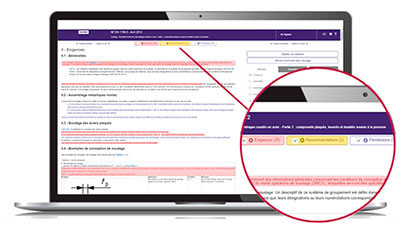
ZOOM ON ... the Requirements department
To comply with a standard, you need to quickly understand its issues in order to determine its impact on your activity.

The Requirements department helps you quickly locate within the normative text:
- mandatory clauses to satisfy,
- non-essential but useful clauses to know, such as permissions and recommendations.

The identification of these types of clauses is based on the document “ISO / IEC Directives, Part 2 - Principles and rules of structure and drafting of ISO documents ”as well as on a constantly enriched list of verbal forms.

With Requirements, quickly access the main part of the normative text!

With Requirements, quickly access the main part of the normative text!
New: UPSELL service
Need to identify, monitor and decipher standards?