
NF EN ISO 14160

NF EN ISO 14160

August 2011
Standard Cancelled

Sterilization of health care products - Liquid chemical sterilizing agents for single-use medical devices utilizing animal tissues and their derivatives - Requirements for characterization, development, validation and routine control of a sterilization process for medical devices

ISO 14160:2011 specifies requirements for the characterization of a liquid chemical sterilizing agent and for the development, validation, process control and monitoring of sterilization by liquid chemical sterilizing agents of single-use medical devices comprising, in whole or in part, materials of animal origin.ISO 14160:2011 covers the control of risks arising from contamination with bacteria and fungi by application of a liquid chemical sterilization process. Risks associated with other microorganisms need to be assessed. ISO 14160:2011 is not applicable to material of human origin.ISO 14160:2011 does not describe methods for the validation of the inactivation of viruses and transmissible spongiform encephalopath (TSE) agents. ISO 14160:2011 does not describe methods for validation of the inactivation, elimination, or elimination and inactivation of protozoa and parasites.The requirements for validation and routine control described in ISO 14160:2011 are only applicable to the defined sterilization process of a medical device, which is performed after the manufacturing process, and do not take account of the lethal effects of other bioburden reduction steps.ISO 14160:2011 does not specify tests to establish the effects of any chosen sterilization method upon the fitness for use of the medical device.ISO 14160:2011 does not cover the level of residual sterilizing agent within medical devices.ISO 14160:2011 does not describe a quality management system for the control of all stages of manufacture.

Main informations

Collections

National standards and national normative documents

Publication date

August 2011

Number of pages

47 p.

Reference

NF EN ISO 14160

ICS Codes

11.080.01   Sterilization and disinfection in general

Classification index

S98-112

Print number

1 - 05/08/2011

International kinship

European kinship

EN ISO 14160:2011
Sumary
Sterilization of health care products - Liquid chemical sterilizing agents for single-use medical devices utilizing animal tissues and their derivatives - Requirements for characterization, development, validation and routine control of a sterilization process for medical devices

ISO 14160:2011 specifies requirements for the characterization of a liquid chemical sterilizing agent and for the development, validation, process control and monitoring of sterilization by liquid chemical sterilizing agents of single-use medical devices comprising, in whole or in part, materials of animal origin.

ISO 14160:2011 covers the control of risks arising from contamination with bacteria and fungi by application of a liquid chemical sterilization process. Risks associated with other microorganisms need to be assessed.

ISO 14160:2011 is not applicable to material of human origin.

ISO 14160:2011 does not describe methods for the validation of the inactivation of viruses and transmissible spongiform encephalopath (TSE) agents.

ISO 14160:2011 does not describe methods for validation of the inactivation, elimination, or elimination and inactivation of protozoa and parasites.

The requirements for validation and routine control described in ISO 14160:2011 are only applicable to the defined sterilization process of a medical device, which is performed after the manufacturing process, and do not take account of the lethal effects of other bioburden reduction steps.

ISO 14160:2011 does not specify tests to establish the effects of any chosen sterilization method upon the fitness for use of the medical device.

ISO 14160:2011 does not cover the level of residual sterilizing agent within medical devices.

ISO 14160:2011 does not describe a quality management system for the control of all stages of manufacture.

Replaced standards (1)
NF EN ISO 14160
June 1998
Standard Cancelled
Validation and routine control of sterilization by liquid chemical sterilants. Sterilization of single-use medical devices incorporating materials of animal origin.

Le présent document spécifie les exigences relatives à la mise au point, à la validation, au contrôle et à la surveillance du procédé de stérilisation par agents stérilisants chimiques liquides, de dispositifs médicaux non réutilisables comprenant en partie ou en totalité des matières d'origine animale.

Standard replaced by (1)
NF EN ISO 14160
June 2021
Standard Current
Sterilization of health care products - Liquid chemical sterilizing agents for single-use medical devices utilizing animal tissues and their derivatives - Requirements for characterization, development, validation and routine control of a sterilization process for medical devices

This document specifies requirements for the characterization of a liquid chemical sterilizing agent and for the development, validation, process control and monitoring of sterilization by liquid chemical sterilizing agents of single-use medical devices comprising, in whole or in part, materials of animal origin. This document covers the control of risks arising from contamination with bacteria and fungi by application of a liquid chemical sterilization process. Risks associated with other microorganisms can be assessed using other methods (see NOTE 1). This document is not applicable to material of human origin. This document does not describe methods for the validation of the inactivation of viruses and transmissible spongiform encephalopathy (TSE) agents (see NOTE 2 and NOTE 3). This document does not describe methods for validation of the inactivation or elimination of protozoa and parasites. The requirements for validation and routine control described in this document are only applicable to the defined sterilization process of a medical device, which is performed after the manufacturing process, and do not take account of the lethal effects of other bioburden reduction steps (see NOTE 4). This document does not specify tests to establish the effects of any chosen sterilization process upon the fitness for use of the medical device (see NOTE 5). This document does not cover the level of residual sterilizing agent within medical devices (see NOTE 6). Guidance for the characterization of a liquid chemical sterilizing agent and for the development, validation, process control and monitoring of sterilization by liquid chemical sterilizing agents of single-use medical devices comprising, in whole or in part, materials of animal origin is provided in informative Annex A. NOTE 1 The prior application of risk management principles to medical devices utilizing animal tissues, as described in ISO 22442-1 is important. ISO 18362 provides information on control of microbial risks during processing of cell-based health-care products. NOTE 2 Liquid chemical sterilizing agents traditionally employed to sterilize animal tissues in medical devices might not be effective in inactivating the causative agents of TSE such as bovine spongiform encephalopathy (BSE), or scrapie. Satisfactory validation in accordance with this document does not necessarily demonstrate inactivation of infective agents of this type. Risk controls related to sourcing, collection and handling of animal materials are described in ISO 22442-2. NOTE 3 The validation of the inactivation, elimination, or elimination and inactivation of viruses and TSE agents is described in ISO 22442-3. NOTE 4 Manufacturing processes for medical devices containing animal tissues frequently include exposure to chemical agents which can significantly reduce the bioburden on the medical device. Following the manufacturing process, a medical device is exposed to a specified sterilization process. NOTE 5 Such testing is a crucial part of the design and development of a medical device. NOTE 6 ISO 10993-17 specifies a method to establish allowable limits for residues of sterilizing agents. NOTE 7 Standards for quality management systems (see ISO 13485) can be used in the control of all stages of manufacture including the sterilization process.

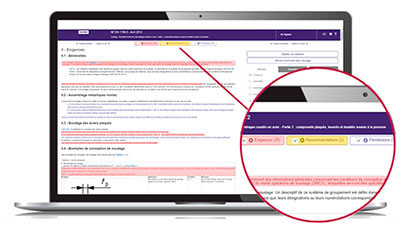
ZOOM ON ... the Requirements department
To comply with a standard, you need to quickly understand its issues in order to determine its impact on your activity.

The Requirements department helps you quickly locate within the normative text:
- mandatory clauses to satisfy,
- non-essential but useful clauses to know, such as permissions and recommendations.

The identification of these types of clauses is based on the document “ISO / IEC Directives, Part 2 - Principles and rules of structure and drafting of ISO documents ”as well as on a constantly enriched list of verbal forms.

With Requirements, quickly access the main part of the normative text!

With Requirements, quickly access the main part of the normative text!
New: UPSELL service
- The UPSELL service allows you to easily update one of your standards.
- With a single click, add a new language, the Requirements or Redline+ service and add one or more additional users.
- Whether you are in the process of acquiring a standard or it is already available in your personal space, the UPSELL service is available at every stage to help you understand it and implement it within your organization.
Need to identify, monitor and decipher standards?

COBAZ is the simple and effective solution to meet the normative needs related to your activity, in France and abroad.

Available by subscription, CObaz is THE modular solution to compose according to your needs today and tomorrow. Quickly discover CObaz!

Request your free, no-obligation live demo

I discover COBAZ