
NF EN ISO 14253-2
Geometrical product specifications (GPS) - Inspection by measurement of workpieces and measuring equipment - Part 2 : guidance for the estimation of uncertainty in GPS measurement, in calibration of measuring equipment and in product verification
ISO 14253-2:2011 gives guidance on the implementation of the concept of the "Guide to the estimation of uncertainty in measurement" (in short GUM) to be applied in industry for the calibration of (measurement) standards and measuring equipment in the field of GPS and the measurement of workpiece GPS characteristics. The aim is to promote full information on how to achieve uncertainty statements and provide the basis for international comparison of measurement results and their uncertainties (relationship between purchaser and supplier). ISO 14253-2:2011 is intended to support ISO 14253-1. Both parts are beneficial to all technical functions in a company in the interpretation of GPS specifications [i.e. tolerances of workpiece characteristics and values of maximum permissible errors (MPEs) for metrological characteristics of measuring equipment].ISO 14253-2:2011 introduces the Procedure for Uncertainty MAnagement (PUMA), which is a practical, iterative procedure based on the GUM for estimating uncertainty of measurement without changing the basic concepts of the GUM. It is intended to be used generally for estimating uncertainty of measurement and giving statements of uncertainty for: single measurement results; the comparison of two or more measurement results; the comparison of measurement results from one or more workpieces or pieces of measurement equipment with given specifications [i.e. maximum permissible errors (MPEs) for a metrological characteristic of a measurement instrument or measurement standard, and tolerance limits for a workpiece characteristic, etc.], for proving conformance or non-conformance with the specification.The iterative method is based basically on an upper bound strategy, i.e. overestimation of the uncertainty at all levels, but the iterations control the amount of overestimation. Intentional overestimation and not underestimation, is necessary to prevent wrong decisions based on measurement results. The amount of overestimation is controlled by economical evaluation of the situation.The iterative method is a tool to maximize profit and minimize cost in the metrological activities of a company. The iterative method/procedure is economically self-adjusting and is also a tool to change/reduce existing uncertainty in measurement with the aim of reducing cost in metrology (manufacture). The iterative method makes it possible to compromise between risk, effort and cost in uncertainty estimation and budgeting.
ISO 14253-2:2011 gives guidance on the implementation of the concept of the "Guide to the estimation of uncertainty in measurement" (in short GUM) to be applied in industry for the calibration of (measurement) standards and measuring equipment in the field of GPS and the measurement of workpiece GPS characteristics. The aim is to promote full information on how to achieve uncertainty statements and provide the basis for international comparison of measurement results and their uncertainties (relationship between purchaser and supplier).
ISO 14253-2:2011 is intended to support ISO 14253-1. Both parts are beneficial to all technical functions in a company in the interpretation of GPS specifications [i.e. tolerances of workpiece characteristics and values of maximum permissible errors (MPEs) for metrological characteristics of measuring equipment].
ISO 14253-2:2011 introduces the Procedure for Uncertainty MAnagement (PUMA), which is a practical, iterative procedure based on the GUM for estimating uncertainty of measurement without changing the basic concepts of the GUM. It is intended to be used generally for estimating uncertainty of measurement and giving statements of uncertainty for: single measurement results; the comparison of two or more measurement results; the comparison of measurement results from one or more workpieces or pieces of measurement equipment with given specifications [i.e. maximum permissible errors (MPEs) for a metrological characteristic of a measurement instrument or measurement standard, and tolerance limits for a workpiece characteristic, etc.], for proving conformance or non-conformance with the specification.
The iterative method is based basically on an upper bound strategy, i.e. overestimation of the uncertainty at all levels, but the iterations control the amount of overestimation. Intentional overestimation and not underestimation, is necessary to prevent wrong decisions based on measurement results. The amount of overestimation is controlled by economical evaluation of the situation.
The iterative method is a tool to maximize profit and minimize cost in the metrological activities of a company. The iterative method/procedure is economically self-adjusting and is also a tool to change/reduce existing uncertainty in measurement with the aim of reducing cost in metrology (manufacture). The iterative method makes it possible to compromise between risk, effort and cost in uncertainty estimation and budgeting.
Dans la série de normes relatives à l'incertitude de mesure, le présent document a pour objectif de présenter des informations sur la façon de déterminer les causes d'incertitudes, afin d'obtenir des résultats de mesurage et des incertitudes comparables. Il représente une mise en oeuvre du "Guide pour l'estimation de l'incertitude de mesure" (GUM) à appliquer dans le domaine GPS. La relation du présent document avec la matrice GPS est donnée à l'Annexe D.
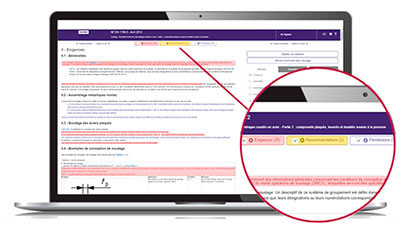
The Requirements department helps you quickly locate within the normative text:
- mandatory clauses to satisfy,
- non-essential but useful clauses to know, such as permissions and recommendations.
The identification of these types of clauses is based on the document “ISO / IEC Directives, Part 2 - Principles and rules of structure and drafting of ISO documents ”as well as on a constantly enriched list of verbal forms.
With Requirements, quickly access the main part of the normative text!

- With a single click, add a new language, the Requirements or Redline+ service and add one or more additional users.
- Whether you are in the process of acquiring a standard or it is already available in your personal space, the UPSELL service is available at every stage to help you understand it and implement it within your organization.
COBAZ is the simple and effective solution to meet the normative needs related to your activity, in France and abroad.
Available by subscription, CObaz is THE modular solution to compose according to your needs today and tomorrow. Quickly discover CObaz!
Request your free, no-obligation live demo
I discover COBAZ