
NF EN ISO 14405-1
NF EN ISO 14405-1

NF EN ISO 14405-1

August 2025
Standard Current

Geometrical product specifications (GPS) - Dimensional tolerancing - Part 1: Linear sizes

Main informations

Collections

National standards and national normative documents

Publication date

August 2025

Number of pages

68 p.

Reference

NF EN ISO 14405-1

ICS Codes

17.040.10   Limits and fits
17.040.40   Geometrical Product Specification (GPS)

International kinship

ISO 14405-1:2025

European kinship

EN ISO 14405-1:2025
Replaced standards (1)
NF EN ISO 14405-1
NF EN ISO 14405-1
December 2016
Standard Cancelled
Geometrical product specifications (GPS) - Dimensional tolerancing - Part 1 : linear sizes

ISO 14405-1:2016 establishes the default specification operator (see ISO 17450?2) for linear size and defines a number of special specification operators for linear size for features of size, e.g. "cylinder", "sphere", "torus,"[1], "circle", "two parallel opposite planes", or "two parallel opposite straight lines". It also defines the specification modifiers and the drawing indications for these linear sizes. It covers the following linear sizes: a) local size: - two-point size; - spherical size; - section size; - portion size; b) global size: - direct global linear size: - least-squares size; - maximum inscribed size; - minimum circumscribed size; - minimax size; - indirect global linear size; c) calculated size: - circumference diameter; - area diameter; - volume diameter; d) rank-order size: - maximum size; - minimum size; - average size; - median size; - mid-range size; - range of sizes; - standard deviation of sizes. ISO 14405-1:2016 defines tolerances of linear sizes for the following: - a + and/or ? limit deviation (e.g. 0/?0,019); - an upper limit of size (ULS) and/or lower limit of size (LLS) (e.g. 15,2 max., 12 min., or 30,2/30,181); - an ISO tolerance class code in accordance with ISO 286?1 (e.g. 10 h6); with or without modifiers. ISO 14405-1:2016 provides a set of tools to express several types of size characteristic. It does not present any information on the relationship between a function or a use and a size characteristic. [1] A torus is a feature of size when its directrix diameter is fixed.

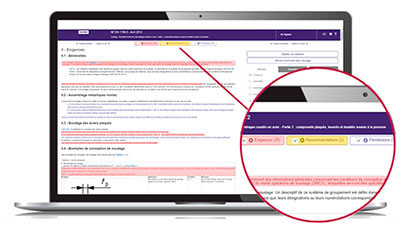
ZOOM ON ... the Requirements department

To comply with a standard, you need to quickly understand its issues in order to determine its impact on your activity.

The Requirements department helps you quickly locate within the normative text:

  • mandatory clauses to satisfy,
  • non-essential but useful clauses to know, such as permissions and recommendations.

The identification of these types of clauses is based on the document "ISO/IEC Directives, Part 2 - Principles and rules of structure and drafting of ISO documents" as well as on a constantly enriched list of verbal forms.

With Requirements, quickly access the main part of the normative text!


What is the Redline format?
New: UPSELL service
Need to identify, monitor and decipher standards?