NF EN ISO 14644-9
NF EN ISO 14644-9

NF EN ISO 14644-9

May 2022
Standard Current

Cleanrooms and associated controlled environments - Part 9: Assessment of surface cleanliness for particle concentration

This document establishes a procedure for the assessment of particle cleanliness levels on solid surfaces in cleanrooms and associated controlled environment applications. Recommendations on testing and measuring methods, as well as information about surface characteristics, are given in Annexes A to D.This document applies to all solid surfaces in cleanrooms and associated controlled environments, such as walls, ceilings, floors, working environments, tools, equipment and products. The procedure for the assessment of surface cleanliness by particle concentration (SCP) is limited to particles of between 0,05 µm and 500 µm.The following issues are not considered in this document:—    requirements for the cleanliness and suitability of surfaces for specific processes;—    procedures for the cleaning of surfaces;—    material characteristics;—    references to interactive bonding forces or generation processes that are usually time-dependent and process-dependent;—    selection and use of statistical methods for assessment and testing;—    other characteristics of particles, such as electrostatic charge, ionic charges and microbiological state.


Main informations

Collections

National standards and national normative documents

Publication date

May 2022

Number of pages

42 p.

Reference

NF EN ISO 14644-9

ICS Codes

13.040.35   Cleanrooms and associated controlled environments

Classification index

X44-101-9

Print number

1

International kinship

ISO 14644-9:2022

European kinship

EN ISO 14644-9:2022
Sumary
Cleanrooms and associated controlled environments - Part 9: Assessment of surface cleanliness for particle concentration

This document establishes a procedure for the assessment of particle cleanliness levels on solid surfaces in cleanrooms and associated controlled environment applications. Recommendations on testing and measuring methods, as well as information about surface characteristics, are given in Annexes A to D.

This document applies to all solid surfaces in cleanrooms and associated controlled environments, such as walls, ceilings, floors, working environments, tools, equipment and products. The procedure for the assessment of surface cleanliness by particle concentration (SCP) is limited to particles of between 0,05 µm and 500 µm.

The following issues are not considered in this document:

—    requirements for the cleanliness and suitability of surfaces for specific processes;

—    procedures for the cleaning of surfaces;

—    material characteristics;

—    references to interactive bonding forces or generation processes that are usually time-dependent and process-dependent;

—    selection and use of statistical methods for assessment and testing;

—    other characteristics of particles, such as electrostatic charge, ionic charges and microbiological state.
Replaced standards (1)
NF EN ISO 14644-9
NF EN ISO 14644-9
September 2012
Standard Cancelled
Cleanrooms and associated controlled environments — Part 9: Classification of surface cleanliness by particle concentration

Table of contents
  • Avant-propos
  • 1 Domaine d'application
  • 2 Références normatives
  • 3 Termes et définitions
  • 4 Termes abrégés
  • 5 Système d'évaluation du niveau de propreté des surfaces
  • 6 Démonstration de la conformité
  • Annexe A (informative) Caractéristiques des surfaces
  • Annexe B (informative) Descripteur pour des domaines granulométriques spécifiques
  • Annexe C (informative) Paramètres influençant l'évaluation des niveaux de gradation SCP
  • Annexe D (informative) Méthodes de mesurage pour la détermination de la propreté des surfaces par la concentration particulaire
  • Bibliographie
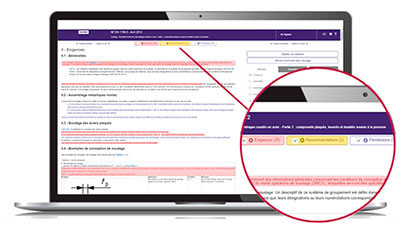
ZOOM ON ... the Requirements department

To comply with a standard, you need to quickly understand its issues in order to determine its impact on your activity.

The Requirements department helps you quickly locate within the normative text:

  • mandatory clauses to satisfy,
  • non-essential but useful clauses to know, such as permissions and recommendations.

The identification of these types of clauses is based on the document "ISO/IEC Directives, Part 2 - Principles and rules of structure and drafting of ISO documents" as well as on a constantly enriched list of verbal forms.

With Requirements, quickly access the main part of the normative text!


What is the Redline format?
New: UPSELL service
Need to identify, monitor and decipher standards?