NF EN ISO 15156-3

NF EN ISO 15156-3

November 2020
Standard Current

Petroleum and natural gas industries - Materials for use in H2S-containing environments in oil and gas production - Part 3 : Cracking-resistant CRAs (corrosion-resistant alloys) and other alloys

This document gives requirements and recommendations for the selection and qualification of CRAs (corrosion-resistant alloys) and other alloys for service in equipment used in oil and natural gas production and natural gas treatment plants in H2S-containing environments whose failure can pose a risk to the health and safety of the public and personnel or to the environment. It can be applied to help avoid costly corrosion damage to the equipment itself. It supplements, but does not replace, the materials requirements of the appropriate design codes, standards, or regulations.This document addresses the resistance of these materials to damage that can be caused by sulfide stress cracking (SSC), stress corrosion cracking (SCC), and galvanically induced hydrogen stress cracking (GHSC).This document is concerned only with cracking. Loss of material by general (mass loss) or localized corrosion is not addressed.Table 1 provides a non-exhaustive list of equipment to which this document is applicable, including exclusions.This document applies to the qualification and selection of materials for equipment designed and constructed using load controlled design methods. For design utilizing strain-based design methods, see ISO 15156?1:2020, Clause 5.This document is not necessarily suitable for application to equipment used in refining or downstream processes and equipment.

Main informations

Collections

National standards and national normative documents

Publication date

November 2020

Number of pages

90 p.

Reference

NF EN ISO 15156-3

ICS Codes

75.180.01   Equipment for petroleum and natural gas industries in general

Classification index

M87-229-3

Print number

1

International kinship

European kinship

EN ISO 15156-3:2020
Sumary
Petroleum and natural gas industries - Materials for use in H2S-containing environments in oil and gas production - Part 3 : Cracking-resistant CRAs (corrosion-resistant alloys) and other alloys

This document gives requirements and recommendations for the selection and qualification of CRAs (corrosion-resistant alloys) and other alloys for service in equipment used in oil and natural gas production and natural gas treatment plants in H2S-containing environments whose failure can pose a risk to the health and safety of the public and personnel or to the environment. It can be applied to help avoid costly corrosion damage to the equipment itself. It supplements, but does not replace, the materials requirements of the appropriate design codes, standards, or regulations.

This document addresses the resistance of these materials to damage that can be caused by sulfide stress cracking (SSC), stress corrosion cracking (SCC), and galvanically induced hydrogen stress cracking (GHSC).

This document is concerned only with cracking. Loss of material by general (mass loss) or localized corrosion is not addressed.

Table 1 provides a non-exhaustive list of equipment to which this document is applicable, including exclusions.

This document applies to the qualification and selection of materials for equipment designed and constructed using load controlled design methods. For design utilizing strain-based design methods, see ISO 15156?1:2020, Clause 5.

This document is not necessarily suitable for application to equipment used in refining or downstream processes and equipment.

Replaced standards (1)
NF EN ISO 15156-3
August 2011
Standard Cancelled
Petroleum and natural gas industries - Materials for use in H2S-containing environments in oil and gas production - Part 3 : cracking-resistant CRAs (corrosion-resistant alloys) and other alloys

ISO 15156-3:2009 gives requirements and recommendations for the selection and qualification of CRAs (corrosion-resistant alloys) and other alloys for service in equipment used in oil and natural gas production and natural gas treatment plants in H2S?containing environments, whose failure can pose a risk to the health and safety of the public and personnel or to the environment. ISO 15156-3:2009 can be applied to help to avoid costly corrosion damage to the equipment itself. It supplements, but does not replace, the materials requirements of the appropriate design codes, standards or regulations. ISO 15156-3:2009 addresses the resistance of these materials to damage that can be caused by sulfide stress?cracking (SSC), stress?corrosion cracking (SCC) and galvanically induced hydrogen stress cracking (GHSC). ISO 15156-3:2009 is concerned only with cracking. Loss of material by general (mass loss) or localized corrosion is not addressed. A non-exhaustive list of equipment is given to which this part of ISO 15156 is applicable, including permitted exclusions. ISO 15156-3:2009 applies to the qualification and selection of materials for equipment designed and constructed using conventional elastic design criteria. For designs utilizing plastic criteria (e.g. strain?based and limit?state designs), see ISO 15156-1:2009, Clause 5. ISO 15156-3:2009 is not necessarily suitable for application to equipment used in refining or downstream processes and equipment.

ZOOM ON ... the Requirements department
To comply with a standard, you need to quickly understand its issues in order to determine its impact on your activity.

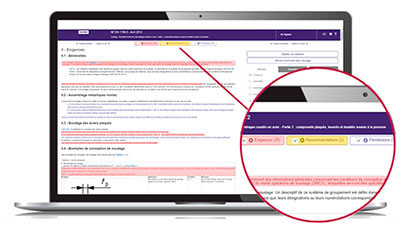
The Requirements department helps you quickly locate within the normative text:
- mandatory clauses to satisfy,
- non-essential but useful clauses to know, such as permissions and recommendations.

The identification of these types of clauses is based on the document “ISO / IEC Directives, Part 2 - Principles and rules of structure and drafting of ISO documents ”as well as on a constantly enriched list of verbal forms.

With Requirements, quickly access the main part of the normative text!

With Requirements, quickly access the main part of the normative text!
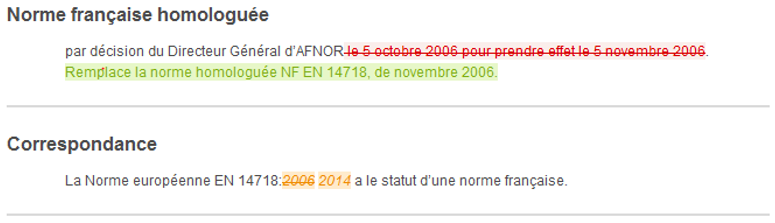
What is the Redline format?
The Redline + service - standards comparator allows you to easily and simply identify major changes between the current standard and its last canceled version.

At a glance, you will be able to identify the additions, deletions or modifications to a text, table, figure and formula.
At a glance, you will be able to identify the additions, deletions or modifications to a text, table, figure and formula

The Redlines + service is offered to you on the collection of French standards in force, in French language and in HTML and PDF format.

For an overview of the service, click on View a standard in redline format
New: UPSELL service
- The UPSELL service allows you to easily update one of your standards.
- With a single click, add a new language, the Requirements or Redline+ service and add one or more additional users.
- Whether you are in the process of acquiring a standard or it is already available in your personal space, the UPSELL service is available at every stage to help you understand it and implement it within your organization.
Need to identify, monitor and decipher standards?

COBAZ is the simple and effective solution to meet the normative needs related to your activity, in France and abroad.

Available by subscription, CObaz is THE modular solution to compose according to your needs today and tomorrow. Quickly discover CObaz!

Request your free, no-obligation live demo

I discover COBAZ