
NF EN ISO 16852
NF EN ISO 16852

NF EN ISO 16852

May 2011
Standard Cancelled

Flame arresters - Performance requirements, test methods and limits for use (ISO 16852:2008, including Cor 1:2008 and Cor 2:2009)

Main informations

Collections

National standards and national normative documents

Publication date

May 2011

Release date

décembre 2024

Number of pages

59 p.

Reference

NF EN ISO 16852

ICS Codes

13.220.10   Fire-fighting
Print number

1 - mai 2011
Replaced standards (1)
NF EN 12874
NF EN 12874
July 2001
Standard Cancelled
Flame arresters - Performance requirements, test methods and limits for use

Le présent document prescrit les exigences applicables aux arrête-flammes qui préviennent la transmission d'une flamme en présence de mélanges inflammables de gaz/air ou de vapeur/air. Il établit des principes de classification, de construction de base et de marquage des arrête-flammes et décrit des méthodes d'essai permettant de vérifier les exigences de sécurité et de déterminer des limites de sécurité d'utilisation.

Standard replaced by (1)
NF EN ISO 16852
NF EN ISO 16852
January 2017
Standard Current
Flame arresters - Performance requirements, test methods and limits for use

ISO 16852:2016 specifies the requirements for flame arresters that prevent flame transmission when explosive gas-air or vapour-air mixtures are present. It establishes uniform principles for the classification, basic construction and information for use, including the marking of flame arresters, and specifies test methods to verify the safety requirements and determine safe limits of use. This International Standard is valid for pressures ranging from 80 kPa to 160 kPa and temperatures ranging from −20 °C to + 150 °C. NOTE 1 For flame arresters with operational conditions inside the scope, but outside atmospheric conditions, see 7.4. NOTE 2 In designing and testing flame arresters for operation under conditions other than those specified above, this International Standard can be used as a guide. However, additional testing related specifically to the intended conditions of use is advisable. This is particularly important when high temperatures and pressures are applied. The test mixtures might need to be modified in these cases. NOTE 3 An additional standard IMO MSC/Circ. 677 for maritime application from IMO (International Maritime Organization) exists. ISO 16852:2016 is not applicable to the following: - external safety-related measurement and control equipment that might be required to keep the operational conditions within the established safe limits; NOTE 4 Integrated measurement and control equipment, such as integrated temperature and flame sensors as well as parts which, for example, intentionally melt (retaining pin), burn away (weather hoods) or bend (bimetallic strips), is within the scope of this International Standard. - flame arresters used for explosive mixtures of vapours and gases, which tend to self-decompose (e.g. acetylene) or which are chemically unstable; - flame arresters used for carbon disulphide, due to its special properties; - flame arresters whose intended use is for mixtures other than gas-air or vapour-air mixtures (e.g. higher oxygen-nitrogen ratio, chlorine as oxidant, etc.); - flame arrester test procedures for internal-combustion compression ignition engines; - fast acting valves, extinguishing systems and other explosion isolating systems.

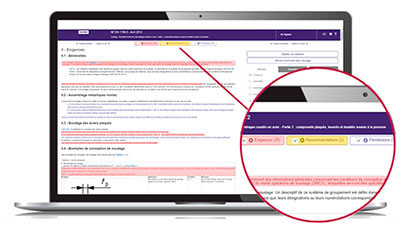
ZOOM ON ... the Requirements department
To comply with a standard, you need to quickly understand its issues in order to determine its impact on your activity.

The Requirements department helps you quickly locate within the normative text:
- mandatory clauses to satisfy,
- non-essential but useful clauses to know, such as permissions and recommendations.

The identification of these types of clauses is based on the document “ISO / IEC Directives, Part 2 - Principles and rules of structure and drafting of ISO documents ”as well as on a constantly enriched list of verbal forms.

With Requirements, quickly access the main part of the normative text!

With Requirements, quickly access the main part of the normative text!
What is the Redline format?
New: UPSELL service
Need to identify, monitor and decipher standards?