NF EN ISO 17892-3

NF EN ISO 17892-3

December 2015
Standard Current

Geotechnical investigation and testing - Laboratory testing of soil - Part 3 : determination of particle density

ISO 17892-3:2015 specifies methods for the determination of the particle density of soils.ISO 17892-3:2015 is applicable to the laboratory determination of the particle density of soil within the scope of geotechnical investigations, and describes two methods, a pycnometer method by fluid displacement and a pycnometer method by gas displacement.The fluid pycnometer method described in this part of ISO 17892 applies to soil types with particle sizes under about 4 mm, or soils crushed to meet this requirement. Larger pycnometers are used for coarser materials. The particle size of soils suitable for testing in the gas pycnometer is limited by the dimensions of the specimen container of the particular gas pycnometer being used.NOTE 1 ISO 17892-3:2015 fulfils the requirements of the determination of particle density of soils for geotechnical investigation and testing in accordance with EN 1997-1 and EN 1997-2.NOTE 2 The presence of dissolved salts in the pore water can affect the results of these tests. Techniques for compensating for dissolved salts are available but are beyond the scope of this standard.


Main informations

Collections

National standards and national normative documents

Publication date

December 2015

Number of pages

23 p.

Reference

NF EN ISO 17892-3

ICS Codes

13.080.20   Physical properties of soils
93.020   Earthworks. Excavations. Foundation construction. Underground works

Classification index

P94-512-3

Print number

1

International kinship

European kinship

EN ISO 17892-3:2015
Sumary
Geotechnical investigation and testing - Laboratory testing of soil - Part 3 : determination of particle density

ISO 17892-3:2015 specifies methods for the determination of the particle density of soils.

ISO 17892-3:2015 is applicable to the laboratory determination of the particle density of soil within the scope of geotechnical investigations, and describes two methods, a pycnometer method by fluid displacement and a pycnometer method by gas displacement.

The fluid pycnometer method described in this part of ISO 17892 applies to soil types with particle sizes under about 4 mm, or soils crushed to meet this requirement. Larger pycnometers are used for coarser materials. The particle size of soils suitable for testing in the gas pycnometer is limited by the dimensions of the specimen container of the particular gas pycnometer being used.

NOTE 1 ISO 17892-3:2015 fulfils the requirements of the determination of particle density of soils for geotechnical investigation and testing in accordance with EN 1997-1 and EN 1997-2.

NOTE 2 The presence of dissolved salts in the pore water can affect the results of these tests. Techniques for compensating for dissolved salts are available but are beyond the scope of this standard.
Replaced standards (2)
XP CEN ISO/TS 17892-3
August 2005
Standard Cancelled
Geotechnical investigation and testing - Laboratory testing of soil - Part 3 : determination of particle density - Pycnometer method

Le présent document concerne la détermination au pycnomètre à eau, de la masse volumique des particules solides de sol dont la dimension des plus gros éléments n'excède pas 2 mm. Il fixe la terminologie, l'appareillage et le mode opératoire relatifs à cet essai.

NF P94-054
October 1991
Standard Cancelled
Soils : investigation and testing. Determination of particle density. Pycnometer method.

La présente norme concerne la détermination au pycnomètre à eau, de la masse volumique des particules solides de sol intact ou remanié dont la dimension des plus gros éléments n'excède pas 2 mm. La présente norme fixe la terminologie, l'appareillage et le mode opératoire relatifs à cet essai.

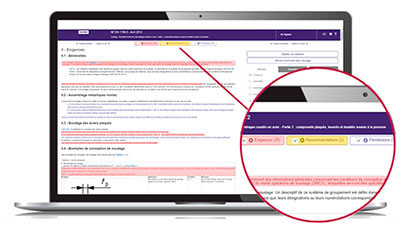
ZOOM ON ... the Requirements department
To comply with a standard, you need to quickly understand its issues in order to determine its impact on your activity.

The Requirements department helps you quickly locate within the normative text:
- mandatory clauses to satisfy,
- non-essential but useful clauses to know, such as permissions and recommendations.

The identification of these types of clauses is based on the document “ISO / IEC Directives, Part 2 - Principles and rules of structure and drafting of ISO documents ”as well as on a constantly enriched list of verbal forms.

With Requirements, quickly access the main part of the normative text!

With Requirements, quickly access the main part of the normative text!
New: UPSELL service
- The UPSELL service allows you to easily update one of your standards.
- With a single click, add a new language, the Requirements or Redline+ service and add one or more additional users.
- Whether you are in the process of acquiring a standard or it is already available in your personal space, the UPSELL service is available at every stage to help you understand it and implement it within your organization.
Need to identify, monitor and decipher standards?

COBAZ is the simple and effective solution to meet the normative needs related to your activity, in France and abroad.

Available by subscription, CObaz is THE modular solution to compose according to your needs today and tomorrow. Quickly discover CObaz!

Request your free, no-obligation live demo

I discover COBAZ