
NF EN ISO 18589-4
NF EN ISO 18589-4

NF EN ISO 18589-4

August 2021
Standard Current

Measurement of radioactivity in the environment - Soil - Part 4: Plutonium 238 and plutonium 239 + 240 - Test method using alpha spectrometry

This document describes a method for measuring 238Pu and 239 + 240 isotopes in soil by alpha spectrometry samples using chemical separation techniques.The method can be used for any type of environmental study or monitoring. These techniques can also be used for measurements of very low levels of activity, one or two orders of magnitude less than the level of natural alpha-emitting radionuclides.The test methods described in this document can also be used to measure the radionuclides in sludge, sediment, construction material and products following proper sampling procedure[2][3][4][5][7][8].The mass of the test portion required depends on the assumed activity of the sample and the desired detection limit. In practice, it can range from 0,1 g to 100 g of the test sample.

Main informations

Collections

National standards and national normative documents

Thematics

Sécurité, Gestion des risques et SST, QSE

Publication date

August 2021

Number of pages

35 p.

Reference

NF EN ISO 18589-4

ICS Codes

13.280   Radiation protection
17.240   Radiation measurements
27.120.01   Nuclear energy in general

Classification index

M60-791-4

Print number

1

International kinship

ISO 18589-4:2019

European kinship

EN ISO 18589-4:2021
Sumary
Measurement of radioactivity in the environment - Soil - Part 4: Plutonium 238 and plutonium 239 + 240 - Test method using alpha spectrometry

This document describes a method for measuring 238Pu and 239 + 240 isotopes in soil by alpha spectrometry samples using chemical separation techniques.

The method can be used for any type of environmental study or monitoring. These techniques can also be used for measurements of very low levels of activity, one or two orders of magnitude less than the level of natural alpha-emitting radionuclides.

The test methods described in this document can also be used to measure the radionuclides in sludge, sediment, construction material and products following proper sampling procedure[2][3][4][5][7][8].

The mass of the test portion required depends on the assumed activity of the sample and the desired detection limit. In practice, it can range from 0,1 g to 100 g of the test sample.

Replaced standards (1)
NF ISO 18589-4
NF ISO 18589-4
August 2020
Standard Cancelled
Measurement of radioactivity in the environment - Soil - Part 4 : plutonium 238 and plutonium 239 + 240 - Test method using alpha spectrometry

This document describes a method for measuring 238Pu and 239 + 240 isotopes in soil by alpha spectrometry samples using chemical separation techniques. The method can be used for any type of environmental study or monitoring. These techniques can also be used for measurements of very low levels of activity, one or two orders of magnitude less than the level of natural alpha-emitting radionuclides. The test methods described in this document can also be used to measure the radionuclides in sludge, sediment, construction material and products following proper sampling procedure[2][3][4][5][7][8]. The mass of the test portion required depends on the assumed activity of the sample and the desired detection limit. In practice, it can range from 0,1 g to 100 g of the test sample.

Table of contents
  • Avant-propos
  • 1 Domaine d'application
  • 2 Références normatives
  • 3 Termes, définitions et symboles
  • 4 Symboles
  • 5 Principe
  • 6 Réactifs chimiques et appareillage
  • 7 Mode opératoire
  • 8 Expression des résultats
  • 9 Rapport d'essai
  • Annexe A (informative) Désorption du plutonium
  • Annexe B (informative) Séparation chimique du plutonium par un solvant organique
  • Annexe C (informative) Séparation chimique du plutonium sur une résine anionique
  • Annexe D (informative) Séparation chimique du plutonium par des résines spécifiques
  • Annexe E (informative) Préparation de la source par électrodéposition
  • Annexe F (informative) Préparation de la source par coprécipitation
  • Bibliographie
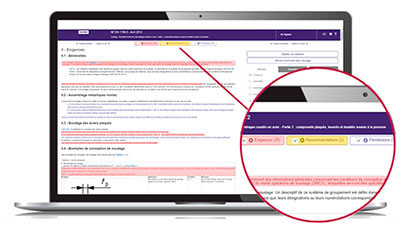
ZOOM ON ... the Requirements department

To comply with a standard, you need to quickly understand its issues in order to determine its impact on your activity.

The Requirements department helps you quickly locate within the normative text:

  • mandatory clauses to satisfy,
  • non-essential but useful clauses to know, such as permissions and recommendations.

The identification of these types of clauses is based on the document "ISO/IEC Directives, Part 2 - Principles and rules of structure and drafting of ISO documents" as well as on a constantly enriched list of verbal forms.

With Requirements, quickly access the main part of the normative text!


What is the Redline format?
New: UPSELL service
Need to identify, monitor and decipher standards?