NF EN ISO 20361
NF EN ISO 20361

NF EN ISO 20361

September 2019
Standard Current

Liquid pumps and pumps units - Noise test code - Grades 2 and 3 of accuracy

This document specifies all the information necessary to carry out efficiently and under standardized conditions the determination, declaration, and verification of the airborne noise emission of liquid pumps or pump units (see 4.1). It specifies the noise measurement methods and the operating and mounting conditions that shall be used for the test.Noise emission characteristics include emission sound pressure levels at specified positions and the sound power level. The determination of these quantities is necessary for— declaring the noise emission values, and— purpose of noise control at source at the design stage.The determination of these quantities is also necessary for comparing the noise emitted by liquid pumps on the market.The use of this document ensures the reproducibility of the determination of the airborne noise-emission characteristics within specified limits determined by the grade of accuracy of the basic airborne noise measurement method used. Noise measurement methods according to this document are engineering methods (grade 2) and survey methods (grade 3).This document does not deal with the characterization of the structure-borne sound and liquid-borne noise generated by liquid pumps.NOTE This document is specified in EN 809+A1 for noise measurements of the pump (or pump unit).

Main informations

Collections

National standards and national normative documents

Publication date

September 2019

Number of pages

36 p.

Reference

NF EN ISO 20361

ICS Codes

17.140.20   Noise emitted by machines and equipment
23.080   Pumps

Classification index

E44-420

Print number

1

International kinship

ISO 20631:2019

European kinship

EN ISO 20361:2019
Sumary
Liquid pumps and pumps units - Noise test code - Grades 2 and 3 of accuracy

This document specifies all the information necessary to carry out efficiently and under standardized conditions the determination, declaration, and verification of the airborne noise emission of liquid pumps or pump units (see 4.1). It specifies the noise measurement methods and the operating and mounting conditions that shall be used for the test.

Noise emission characteristics include emission sound pressure levels at specified positions and the sound power level. The determination of these quantities is necessary for

— declaring the noise emission values, and

— purpose of noise control at source at the design stage.

The determination of these quantities is also necessary for comparing the noise emitted by liquid pumps on the market.

The use of this document ensures the reproducibility of the determination of the airborne noise-emission characteristics within specified limits determined by the grade of accuracy of the basic airborne noise measurement method used. Noise measurement methods according to this document are engineering methods (grade 2) and survey methods (grade 3).

This document does not deal with the characterization of the structure-borne sound and liquid-borne noise generated by liquid pumps.

NOTE This document is specified in EN 809+A1 for noise measurements of the pump (or pump unit).

Replaced standards (1)
NF EN ISO 20361
NF EN ISO 20361
August 2015
Standard Cancelled
Liquid pumps and pump units - Noise test code - Grades 2 and 3 of accuracy

ISO 20361:2015 specifies all the information necessary to carry out efficiently and under standardized conditions the determination, declaration, and verification of the airborne noise emission of liquid pumps or pump units. It specifies the noise measurement methods and the operating and mounting conditions that shall be used for the test. Noise emission characteristics include emission sound pressure levels at specified positions and the sound power level. The determination of these quantities is necessary for declaring the noise emission values, and purpose of noise control at source at the design stage. The determination of these quantities is also necessary for comparing the noise emitted by liquid pumps on the market. The use of ISO 20361:2015 ensures the reproducibility of the determination of the airborne noise-emission characteristics within specified limits determined by the grade of accuracy of the basic airborne noise measurement method used. Noise measurement methods according to ISO 20361:2015 are engineering methods (grade 2) and survey methods (grade 3). ISO 20361:2015 does not deal with the characterization of the structure-borne sound and liquid-borne noise generated by liquid pumps.

Table of contents
  • Avant-propos
  • 1 Domaine d'application
  • 2 Références normatives
  • 3 Termes et définitions
  • 4 Groupe et configuration de pompes
  • 5 Détermination du niveau de puissance acoustique
  • 6 Détermination du niveau de pression acoustique d'émission
  • 7 Incertitude
  • 8 Conditions d'installation et de montage
  • 9 Conditions de fonctionnement lors du mesurage du bruit
  • 10 Informations à enregistrer et à consigner
  • 11 Déclaration et vérification des valeurs d'émission sonore
  • Annexe A (normative) Pompe seule - Surface de mesure
  • Annexe B (normative) Groupes motopompes - Positions microphoniques pour le mesurage du niveau de pression acoustique sur la surface de mesure pour différents types et dimensions de pompes
  • Annexe C (informative) Exemple de déclaration de valeur dissociée d'émission sonore
  • Annexe ZA (informative) Relation entre la présente Norme européenne et les exigences essentielles concernées de la Directive 2006/42/CE
  • Bibliographie
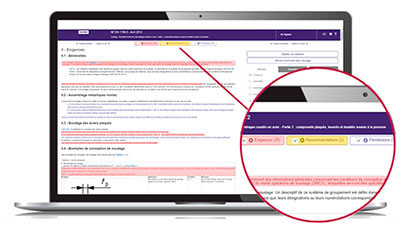
ZOOM ON ... the Requirements department
To comply with a standard, you need to quickly understand its issues in order to determine its impact on your activity.

The Requirements department helps you quickly locate within the normative text:
- mandatory clauses to satisfy,
- non-essential but useful clauses to know, such as permissions and recommendations.

The identification of these types of clauses is based on the document “ISO / IEC Directives, Part 2 - Principles and rules of structure and drafting of ISO documents ”as well as on a constantly enriched list of verbal forms.

With Requirements, quickly access the main part of the normative text!

With Requirements, quickly access the main part of the normative text!
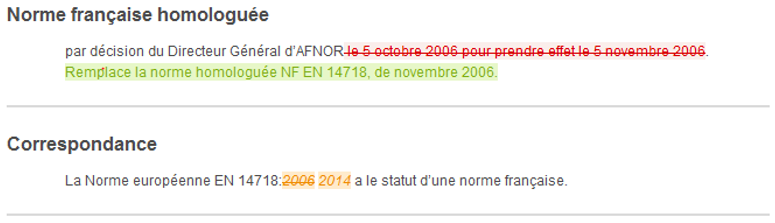
What is the Redline format?
New: UPSELL service
Need to identify, monitor and decipher standards?