
NF EN ISO 20685

NF EN ISO 20685

August 2010
Standard Cancelled

3-D scanning methodologies for internationally compatible anthropometric databases

ISO 20685:2010 addresses protocols for the use of 3-D surface-scanning systems in the acquisition of human body shape data and measurements defined in ISO 7250-1 that can be extracted from 3-D scans. It does not apply to instruments that measure the location and/or motion of individual landmarks.While mainly concerned with whole-body scanners, it is also applicable to body-segment scanners (head scanners, hand scanners, foot scanners).The intended audience is those who use 3-D scanners to create 1-D anthropometric databases and the users of 1-D anthropometric data from 3-D scanners. Although not necessarily aimed at the designers and manufacturers of those systems, scanner designers and manufacturers will find it useful in meeting the needs of clients who build and use 1‑D anthropometric databases.

Main informations

Collections

National standards and national normative documents

Thematics

, , , ,

Publication date

August 2010

Number of pages

28 p.

Reference

NF EN ISO 20685

ICS Codes

13.180   Ergonomics

Classification index

X35-012

Print number

1 - 23/08/2010

International kinship

European kinship

EN ISO 20685:2010
Sumary
3-D scanning methodologies for internationally compatible anthropometric databases

ISO 20685:2010 addresses protocols for the use of 3-D surface-scanning systems in the acquisition of human body shape data and measurements defined in ISO 7250-1 that can be extracted from 3-D scans. It does not apply to instruments that measure the location and/or motion of individual landmarks.

While mainly concerned with whole-body scanners, it is also applicable to body-segment scanners (head scanners, hand scanners, foot scanners).

The intended audience is those who use 3-D scanners to create 1-D anthropometric databases and the users of 1-D anthropometric data from 3-D scanners. Although not necessarily aimed at the designers and manufacturers of those systems, scanner designers and manufacturers will find it useful in meeting the needs of clients who build and use 1‑D anthropometric databases.

Replaced standards (1)
NF EN ISO 20685
March 2006
Standard Cancelled
3-D scanning methodologies for internationally compatible anthropometric databases

ISO 20685:2005 addresses protocols for the use of 3-D surface-scanning systems in the acquisition of human body shape data and measurements defined in ISO 7250 that can be extracted from 3-D scans. It does not apply to instruments that measure the location and/or motion of individual landmarks. While mainly concerned with whole-body scanners, it is also applicable to body-segment scanners (head scanners, hand scanners, foot scanners).

Standard replaced by (1)
NF EN ISO 20685-1
December 2018
Standard Current
3-D scanning methodologies for internationally compatible anthropometric databases - Part 1 : evaluation protocol for body dimensions extracted from 3-D body scans

This document addresses protocols for the use of 3-D surface-scanning systems in the acquisition of human body shape data and measurements defined in ISO 7250-1 that can be extracted from 3-D scans. While mainly concerned with whole-body scanners, it is also applicable to body-segment scanners (head scanners, hand scanners, foot scanners). It does not apply to instruments that measure the location and/or motion of individual landmarks. The intended audience is those who use 3-D scanners to create 1-D anthropometric databases and the users of 1-D anthropometric data from 3-D scanners. Although not necessarily aimed at the designers and manufacturers of those systems, scanner designers and manufacturers can find it useful in meeting the needs of clients who build and use 1‑D anthropometric databases.

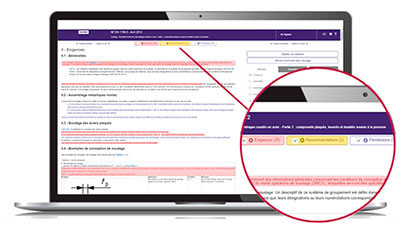
ZOOM ON ... the Requirements department
To comply with a standard, you need to quickly understand its issues in order to determine its impact on your activity.

The Requirements department helps you quickly locate within the normative text:
- mandatory clauses to satisfy,
- non-essential but useful clauses to know, such as permissions and recommendations.

The identification of these types of clauses is based on the document “ISO / IEC Directives, Part 2 - Principles and rules of structure and drafting of ISO documents ”as well as on a constantly enriched list of verbal forms.

With Requirements, quickly access the main part of the normative text!

With Requirements, quickly access the main part of the normative text!
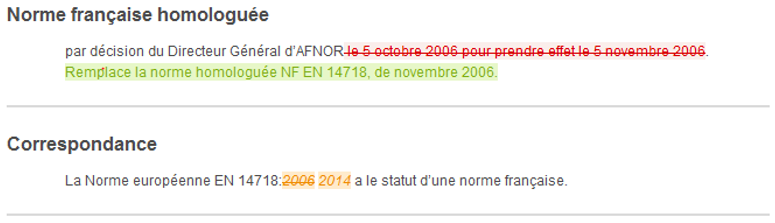
What is the Redline format?
The Redline + service - standards comparator allows you to easily and simply identify major changes between the current standard and its last canceled version.

At a glance, you will be able to identify the additions, deletions or modifications to a text, table, figure and formula.
At a glance, you will be able to identify the additions, deletions or modifications to a text, table, figure and formula

The Redlines + service is offered to you on the collection of French standards in force, in French language and in HTML and PDF format.

For an overview of the service, click on View a standard in redline format
New: UPSELL service
- The UPSELL service allows you to easily update one of your standards.
- With a single click, add a new language, the Requirements or Redline+ service and add one or more additional users.
- Whether you are in the process of acquiring a standard or it is already available in your personal space, the UPSELL service is available at every stage to help you understand it and implement it within your organization.
Need to identify, monitor and decipher standards?

COBAZ is the simple and effective solution to meet the normative needs related to your activity, in France and abroad.

Available by subscription, CObaz is THE modular solution to compose according to your needs today and tomorrow. Quickly discover CObaz!

Request your free, no-obligation live demo

I discover COBAZ