

NF EN ISO 20932-2
NF EN ISO 20932-2

NF EN ISO 20932-2

February 2020
Standard Current

Textiles - Determination of the elasticity of fabrics - Part 2 : multiaxial tests

This document specifies the test methods which can be used to measure elasticity and related properties of fabrics when they undergo a deformation of their surface. Two methods are specified: a dynamic method (method A) and a static method (method B). This document does not apply to narrow fabrics.The results obtained cannot be compared. The choice of test method are agreed between parties and indicated in the test report.

Main informations

Collections

National standards and national normative documents

Publication date

February 2020

Number of pages

29 p.

Reference

NF EN ISO 20932-2

ICS Codes

59.080.30   Textile fabrics

Classification index

G07-200-2

Print number

1

International kinship

ISO 20932-2:2018

European kinship

EN ISO 20932-2:2020
Sumary
Textiles - Determination of the elasticity of fabrics - Part 2 : multiaxial tests

This document specifies the test methods which can be used to measure elasticity and related properties of fabrics when they undergo a deformation of their surface. Two methods are specified: a dynamic method (method A) and a static method (method B). This document does not apply to narrow fabrics.

The results obtained cannot be compared. The choice of test method are agreed between parties and indicated in the test report.

Replaced standards (1)
NF EN 14704-2
NF EN 14704-2
April 2007
Standard Cancelled
Determination of the elasticity of fabrics - Part 2 : multiaxial tests

Le présent document spécifie les méthodes d'essai qui peuvent être appliquées pour mesurer l'élasticité et les propriétés afférentes des étoffes lorsqu'elles sont soumises à la déformation de leur surface, à l'exclusion des étoffes étroites. Il spécifie deux méthodes, l'une dynamique (méthode A) et l'autre statique (méthode B). Les résultats obtenus ne peuvent être comparés. Il convient que le choix de la méthode fasse l'objet d'un accord entre les parties intéressées et soit indiqué dans le rapport d'essai.

Table of contents
  • Avant-propos
  • 1 DomaineDomaine
  • 2 RéférencesRéférences normativesnormatives
  • 3 TermesTermes etet définitionsdéfinitions
  • 4 PrincipePrincipe
  • 5 ÉchantillonnageÉchantillonnage
  • 6 AtmosphèresAtmosphères dede conditionnementconditionnement etet dd'essaiessai
  • 7 PréparationPréparation desdes éprouvetteséprouvettes
  • 8 MéthodeMéthode AA - EssaiEssai dynamiquedynamique
  • 9 MéthodeMéthode BB - EssaiEssai statiquestatique
  • Annexe A (informative) Exemple de graphe type desde cyclescycle
  • Annexe B (informative) Mode d'échantillonnage
  • Annexe C (informative) Exemple de modèleschéma de découpage des éprouvettes dans unà partir de l'échantillon pour laboratoireéchantillon pour laboratoire
  • Annexe D (informative) Méthode A - Équipement d'essai dynamique
  • Annexe E (informative) Méthode B - Équipement d'essai statique
  • Bibliographie
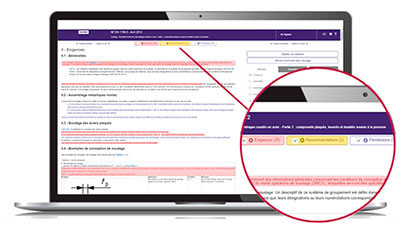
ZOOM ON ... the Requirements department

To comply with a standard, you need to quickly understand its issues in order to determine its impact on your activity.

The Requirements department helps you quickly locate within the normative text:

  • mandatory clauses to satisfy,
  • non-essential but useful clauses to know, such as permissions and recommendations.

The identification of these types of clauses is based on the document "ISO/IEC Directives, Part 2 - Principles and rules of structure and drafting of ISO documents" as well as on a constantly enriched list of verbal forms.

With Requirements, quickly access the main part of the normative text!


What is the Redline format?
New: UPSELL service
Need to identify, monitor and decipher standards?