
NF EN ISO 3251

NF EN ISO 3251

April 2008
Standard Cancelled

Paints, varnishes and plastics - Determination of non-volatile-matter content

ISO 3251:2008 specifies a method for determining the non-volatile-matter content by mass of paints, varnishes, binders for paints and varnishes, polymer dispersions and condensation resins such as phenolic resins (resols, novolak solutions, etc.).The method is also applicable to formulated dispersions containing fillers, pigments and other auxiliaries (e.g. thickeners and film-forming agents). For the method to be usable for unplasticized polymer dispersions and rubber latices, the non-volatile residue (which consists essentially of the polymeric material and of small quantities of auxiliaries such as emulsifiers, protective colloids, stabilizers, solvents added as film-forming agents and — especially for rubber latex concentrate — preserving agents) has to be chemically stable under the test conditions. For plasticized samples, the residue, by definition, normally includes the plasticizer.

Main informations

Collections

National standards and national normative documents

Publication date

April 2008

Number of pages

13 p.

Reference

NF EN ISO 3251

ICS Codes

87.040   Paints and varnishes

Classification index

T30-084

Print number

1 - 02/04/2008

International kinship

European kinship

EN ISO 3251:2008
Sumary
Paints, varnishes and plastics - Determination of non-volatile-matter content

ISO 3251:2008 specifies a method for determining the non-volatile-matter content by mass of paints, varnishes, binders for paints and varnishes, polymer dispersions and condensation resins such as phenolic resins (resols, novolak solutions, etc.).

The method is also applicable to formulated dispersions containing fillers, pigments and other auxiliaries (e.g. thickeners and film-forming agents). For the method to be usable for unplasticized polymer dispersions and rubber latices, the non-volatile residue (which consists essentially of the polymeric material and of small quantities of auxiliaries such as emulsifiers, protective colloids, stabilizers, solvents added as film-forming agents and — especially for rubber latex concentrate — preserving agents) has to be chemically stable under the test conditions. For plasticized samples, the residue, by definition, normally includes the plasticizer.

Replaced standards (1)
NF EN ISO 3251
July 2003
Standard Cancelled
Paints, varnishes and plastics - Determination of non-volatile matter content

Le présent document décrit une méthode d'essai pour déterminer l'extrait sec en masse des peintures et vernis, des résines et solutions de résines et des dispersions de polymères.

Standard replaced by (1)
NF EN ISO 3251
June 2019
Standard Current
Paints, varnishes and plastics - Determination of non-volatile-matter content

This document specifies a method for determining the non-volatile-matter content by mass of paints, varnishes, binders for paints and varnishes, polymer dispersions and condensation resins such as phenolic resins (resols, novolak solutions etc.). The method is also applicable to formulated dispersions containing fillers, pigments and other auxiliaries (e.g. thickeners, film-forming agents). NOTE 1 The non-volatile-matter content of a product is not an absolute quantity but depends upon the temperature and period of heating used for the determination. Consequently, when using this method, only relative and not true values for non-volatile-matter content are obtained owing to solvent retention, thermal decomposition and evaporation of low molecular mass constituents. The method is therefore primarily intended for testing different batches of the same type of product. NOTE 2 This method is suitable for synthetic rubber lattices, provided heating for a specific period of time is considered appropriate (ISO 124 specifies heating until the loss in mass of a 2 g test portion following successive periods of heating is less than 0,5 mg). NOTE 3 In-house methods for determining non-volatile matter often include drying with infrared or microwave radiation. Standardization of such methods is not possible, since they are not generally applicable. Several polymer compositions tend to decompose during such treatment and therefore give incorrect results.

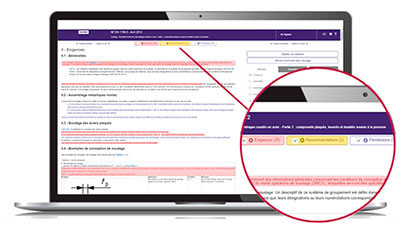
ZOOM ON ... the Requirements department
To comply with a standard, you need to quickly understand its issues in order to determine its impact on your activity.

The Requirements department helps you quickly locate within the normative text:
- mandatory clauses to satisfy,
- non-essential but useful clauses to know, such as permissions and recommendations.

The identification of these types of clauses is based on the document “ISO / IEC Directives, Part 2 - Principles and rules of structure and drafting of ISO documents ”as well as on a constantly enriched list of verbal forms.

With Requirements, quickly access the main part of the normative text!

With Requirements, quickly access the main part of the normative text!
New: UPSELL service
- The UPSELL service allows you to easily update one of your standards.
- With a single click, add a new language, the Requirements or Redline+ service and add one or more additional users.
- Whether you are in the process of acquiring a standard or it is already available in your personal space, the UPSELL service is available at every stage to help you understand it and implement it within your organization.
Need to identify, monitor and decipher standards?

COBAZ is the simple and effective solution to meet the normative needs related to your activity, in France and abroad.

Available by subscription, CObaz is THE modular solution to compose according to your needs today and tomorrow. Quickly discover CObaz!

Request your free, no-obligation live demo

I discover COBAZ