

NF EN ISO 4263-2
NF EN ISO 4263-2

NF EN ISO 4263-2

April 2003
Standard Current

Petroleum and related products - Determination of the ageing behaviour of inhibited oils and fluids - TOST test - Part 2 : procedure for category HFC hydraulic fluids

Le présent document prescrit une méthode permettant d''évaluer le comportement au vieillissement des fluides hydrauliques de catégorie HFC. Dans cette méthode, le vieillissement est accéléré par la présence d''oxygène, d''eau et de catalyseurs métalliques à température élevée. La dégradation du fluide est suivie par l''évolution de la valeur du pH et de la teneur en produits insolubles.

Main informations

Collections

National standards and national normative documents

Publication date

April 2003

Number of pages

21 p.

Reference

NF EN ISO 4263-2

ICS Codes

75.120   Hydraulic fluids

European kinship

EN ISO 4263-2:2003
Sumary
Petroleum and related products - Determination of the ageing behaviour of inhibited oils and fluids - TOST test - Part 2 : procedure for category HFC hydraulic fluids

Le présent document prescrit une méthode permettant d''évaluer le comportement au vieillissement des fluides hydrauliques de catégorie HFC. Dans cette méthode, le vieillissement est accéléré par la présence d''oxygène, d''eau et de catalyseurs métalliques à température élevée. La dégradation du fluide est suivie par l''évolution de la valeur du pH et de la teneur en produits insolubles.
Replaced standards (1)
NF ISO 4263
NF ISO 4263
December 1999
Standard Cancelled
Petroleum products - Inhibited mineral oils - Determination of oxidation characteristics

Specifies a method for evaluating oxidation stability of inhibited steam-turbine oils in the presence of oxygen, water, and metallic copper and iron at an elevated temperature. The method is also used for testing other oils such as hydraulic oils and circulating oils having a relative density less than that of water and containing rust and oxidation inhibitors. This method is used for specification purposes and is considered of value in evaluating the oxidation stability of lubricants, especially those that are prone to water contamination.

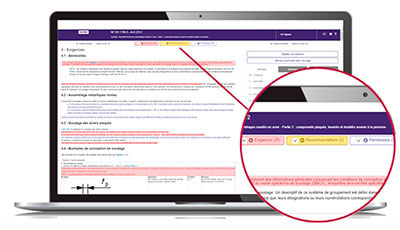
ZOOM ON ... the Requirements department

To comply with a standard, you need to quickly understand its issues in order to determine its impact on your activity.

The Requirements department helps you quickly locate within the normative text:

  • mandatory clauses to satisfy,
  • non-essential but useful clauses to know, such as permissions and recommendations.

The identification of these types of clauses is based on the document "ISO/IEC Directives, Part 2 - Principles and rules of structure and drafting of ISO documents" as well as on a constantly enriched list of verbal forms.

With Requirements, quickly access the main part of the normative text!


New: UPSELL service
Need to identify, monitor and decipher standards?