
NF EN ISO 5136

NF EN ISO 5136

October 2009
Standard Current

Acoustics - Determination of sound power radiated into a duct by fans and other air-moving devices - In-duct method

ISO 5136 specifies a method for testing ducted fans and other air-moving devices to determine the sound power radiated into an anechoically terminated duct on the inlet and/or outlet side of the equipment.The method is applicable to fans which emit steady, broad-band, narrow-band and discrete-frequency sound and to air temperatures between - 50 °C and + 70 °C. The test duct diameter range is from 0,15 m to 2 m. Test methods for small (d < 0,15 m) and large (d > 2 m) test ducts are described in the informative annexes H and I, respectively.The maximum mean flow velocity at the microphone head for which the method is suitable, depends on the type of microphone shield used, and is as follows:foam ball 15 m/s; nose cone 20 m/s; sampling tube 40 m/s.Above these values the suppression of turbulent pressure fluctuations by the microphone shield may be insufficient.The method described in ISO 5136 is applicable to a sound source in which a fan is connected to ducts on at least one side. It is also applicable to other fan/attenuator combinations or equipment incorporating fans which can be considered as "black boxes".Examples of fans and other equipment covered by ISO 5136 areducted centrifugal fans, ducted axial flow fans, ducted mixed-flow fans, ducted air-handling units, ducted dust-collection units, ducted air-conditioning units, and ducted furnaces.ISO 5136 is also applicable to other aerodynamic sources such as boxes, dampers and throttle devices provided that a quiet air flow delivered by an auxiliary fan is available, and the signal-to-noise ratio of sound pressures to turbulent pressure fluctuations in the test duct is at least 6 dB.It is not applicable to non-ducted fans or equipment.

Main informations

Collections

National standards and national normative documents

Publication date

October 2009

Number of pages

80 p.

Reference

NF EN ISO 5136

ICS Codes

17.140.20   Noise emitted by machines and equipment
23.120   Ventilators. Fans. Air-conditioners

Classification index

S31-063

Print number

1 - 24/02/2010

International kinship

European kinship

EN ISO 5136:2009
Sumary
Acoustics - Determination of sound power radiated into a duct by fans and other air-moving devices - In-duct method

ISO 5136 specifies a method for testing ducted fans and other air-moving devices to determine the sound power radiated into an anechoically terminated duct on the inlet and/or outlet side of the equipment.

The method is applicable to fans which emit steady, broad-band, narrow-band and discrete-frequency sound and to air temperatures between - 50 °C and + 70 °C. The test duct diameter range is from 0,15 m to 2 m. Test methods for small (d < 0,15 m) and large (d > 2 m) test ducts are described in the informative annexes H and I, respectively.

The maximum mean flow velocity at the microphone head for which the method is suitable, depends on the type of microphone shield used, and is as follows:

foam ball 15 m/s; nose cone 20 m/s; sampling tube 40 m/s.

Above these values the suppression of turbulent pressure fluctuations by the microphone shield may be insufficient.

The method described in ISO 5136 is applicable to a sound source in which a fan is connected to ducts on at least one side. It is also applicable to other fan/attenuator combinations or equipment incorporating fans which can be considered as "black boxes".

Examples of fans and other equipment covered by ISO 5136 are

ducted centrifugal fans, ducted axial flow fans, ducted mixed-flow fans, ducted air-handling units, ducted dust-collection units, ducted air-conditioning units, and ducted furnaces.

ISO 5136 is also applicable to other aerodynamic sources such as boxes, dampers and throttle devices provided that a quiet air flow delivered by an auxiliary fan is available, and the signal-to-noise ratio of sound pressures to turbulent pressure fluctuations in the test duct is at least 6 dB.

It is not applicable to non-ducted fans or equipment.

Replaced standards (1)
NF EN ISO 5136
October 2003
Standard Cancelled
Acoustics - Determination of sound power radiated into a duct by fans and other air-moving devices - In-duct method

ISO 5136 specifies a method for testing ducted fans and other air-moving devices to determine the sound power radiated into an anechoically terminated duct on the inlet and/or outlet side of the equipment. The method is applicable to fans which emit steady, broad-band, narrow-band and discrete-frequency sound and to air temperatures between - 50 °C and + 70 °C. The test duct diameter range is from 0,15 m to 2 m. Test methods for small (d &lt; 0,15 m) and large (d &gt; 2 m) test ducts are described in the informative annexes H and I, respectively. The maximum mean flow velocity at the microphone head for which the method is suitable, depends on the type of microphone shield used, and is as follows: foam ball 15 m/s; nose cone 20 m/s; sampling tube 40 m/s. Above these values the suppression of turbulent pressure fluctuations by the microphone shield may be insufficient. The method described in ISO 5136 is applicable to a sound source in which a fan is connected to ducts on at least one side. It is also applicable to other fan/attenuator combinations or equipment incorporating fans which can be considered as "black boxes". Examples of fans and other equipment covered by ISO 5136 are ducted centrifugal fans, ducted axial flow fans, ducted mixed-flow fans, ducted air-handling units, ducted dust-collection units, ducted air-conditioning units, and ducted furnaces. ISO 5136 is also applicable to other aerodynamic sources such as boxes, dampers and throttle devices provided that a quiet air flow delivered by an auxiliary fan is available, and the signal-to-noise ratio of sound pressures to turbulent pressure fluctuations in the test duct is at least 6 dB. It is not applicable to non-ducted fans or equipment.

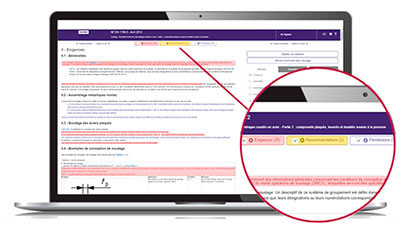
ZOOM ON ... the Requirements department
To comply with a standard, you need to quickly understand its issues in order to determine its impact on your activity.

The Requirements department helps you quickly locate within the normative text:
- mandatory clauses to satisfy,
- non-essential but useful clauses to know, such as permissions and recommendations.

The identification of these types of clauses is based on the document “ISO / IEC Directives, Part 2 - Principles and rules of structure and drafting of ISO documents ”as well as on a constantly enriched list of verbal forms.

With Requirements, quickly access the main part of the normative text!

With Requirements, quickly access the main part of the normative text!
New: UPSELL service
- The UPSELL service allows you to easily update one of your standards.
- With a single click, add a new language, the Requirements or Redline+ service and add one or more additional users.
- Whether you are in the process of acquiring a standard or it is already available in your personal space, the UPSELL service is available at every stage to help you understand it and implement it within your organization.
Need to identify, monitor and decipher standards?

COBAZ is the simple and effective solution to meet the normative needs related to your activity, in France and abroad.

Available by subscription, CObaz is THE modular solution to compose according to your needs today and tomorrow. Quickly discover CObaz!

Request your free, no-obligation live demo

I discover COBAZ