NF EN ISO 527-5
NF EN ISO 527-5

NF EN ISO 527-5

December 2021
Standard Current

Plastics - Determination of tensile properties - Part 5 : test conditions for unidirectional fibre-reinforced plastic composites

This document specifies the test conditions for the determination of the tensile properties of unidirectional fibre-reinforced plastic composites, based upon the general principles given in ISO 527-1.NOTE      Isotropic and orthotropic reinforced materials are covered by ISO 527-4.The methods are used to investigate the tensile behaviour of the test specimens and for determining the tensile strength, tensile modulus, Poisson's ratios and other aspects of the tensile stress-strain relationship under the conditions defined.The test method is suitable for all polymer matrix systems reinforced with unidirectional fibres and which meet the requirements, including failure mode, set out in this document.The method is suitable for composites with either thermoplastic or thermosetting matrices, including preimpregnated materials (prepregs). The reinforcements covered include carbon fibres, glass fibres, aramid fibres and other similar fibres. The reinforcement geometries covered include unidirectional (i.e. completely aligned) fibres and rovings and unidirectional fabrics and tapes.The method is not normally suitable for multidirectional materials composed of several unidirectional layers at different angles (see ISO 527-4).


Main informations

Collections

National standards and national normative documents

Publication date

December 2021

Number of pages

29 p.

Reference

NF EN ISO 527-5

ICS Codes

83.080.01   Plastics in general
83.120   Reinforced plastics

Classification index

T51-034-5

Print number

1

International kinship

ISO 527-5:2021

European kinship

EN ISO 527-5:2021
Sumary
Plastics - Determination of tensile properties - Part 5 : test conditions for unidirectional fibre-reinforced plastic composites

This document specifies the test conditions for the determination of the tensile properties of unidirectional fibre-reinforced plastic composites, based upon the general principles given in ISO 527-1.

NOTE      Isotropic and orthotropic reinforced materials are covered by ISO 527-4.

The methods are used to investigate the tensile behaviour of the test specimens and for determining the tensile strength, tensile modulus, Poisson's ratios and other aspects of the tensile stress-strain relationship under the conditions defined.

The test method is suitable for all polymer matrix systems reinforced with unidirectional fibres and which meet the requirements, including failure mode, set out in this document.

The method is suitable for composites with either thermoplastic or thermosetting matrices, including preimpregnated materials (prepregs). The reinforcements covered include carbon fibres, glass fibres, aramid fibres and other similar fibres. The reinforcement geometries covered include unidirectional (i.e. completely aligned) fibres and rovings and unidirectional fabrics and tapes.

The method is not normally suitable for multidirectional materials composed of several unidirectional layers at different angles (see ISO 527-4).
Replaced standards (1)
NF EN ISO 527-5
NF EN ISO 527-5
October 2009
Standard Cancelled
Plastics - Determination of tensile properties - Part 5: Test conditions for unidirectional fibre-reinforced plastic composites

Table of contents
  • Avant-propos
  • 1 Domaine d'application
  • 2 Références normatives
  • 3 Termes et définitions
  • 4 Principe
  • 5 Appareillage
  • 6 Éprouvettes
  • 7 Nombre d'éprouvettes
  • 8 Conditionnement
  • 9 Mode opératoire
  • 10 Calcul et expression des résultats
  • 11 Fidélité
  • 12 Rapport d'essai
  • Annexe C (normative) Préparation des éprouvettes (type A et type B)
  • Annexe A (informative) Alignement des éprouvettes
  • Annexe B (informative) Utilisation de talons non collés et conditions de serrage sans talons avec des mors à surfaces fines
  • Bibliographie
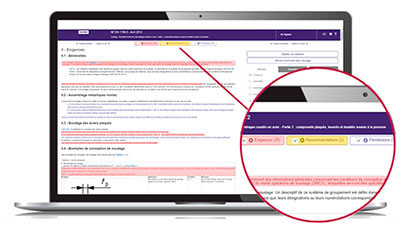
ZOOM ON ... the Requirements department

To comply with a standard, you need to quickly understand its issues in order to determine its impact on your activity.

The Requirements department helps you quickly locate within the normative text:

  • mandatory clauses to satisfy,
  • non-essential but useful clauses to know, such as permissions and recommendations.

The identification of these types of clauses is based on the document "ISO/IEC Directives, Part 2 - Principles and rules of structure and drafting of ISO documents" as well as on a constantly enriched list of verbal forms.

With Requirements, quickly access the main part of the normative text!


What is the Redline format?
New: UPSELL service
Need to identify, monitor and decipher standards?