

NF EN ISO 7391-1

NF EN ISO 7391-1

June 2006
Standard Cancelled

Plastics - Polycarbonate (PC) moulding and extrusion materials - Part 1 : designation system and basis for specifications

ISO 7391-1:2006 establishes a system of designation for polycarbonate thermoplastic material, which may be used as the basis for specifications.The types of polycarbonate plastic are differentiated from each other by a classification system based on appropriate levels of the designatory propertiesviscosity numbermelt volume-flow rateCharpy impact strengthand on information about the intended application and/or method of processing, important properties, additives, colorants, fillers and reinforcing materials.This part of ISO 7391 is applicable to thermoplastic polyesters of carbonic acid and aromatic dihydroxy compounds. The polyester may be a homopolymer, a copolymer or a mixture of the two.It applies to materials ready for normal use in the form of powder, granules or pellets and to materials unmodified or modified by colorants, additives, fillers, etc.

Main informations

Collections

National standards and national normative documents

Publication date

June 2006

Number of pages

13 p.

Reference

NF EN ISO 7391-1

ICS Codes

83.080.20   Thermoplastic materials

Classification index

T53-032-1

Print number

1 - 15/05/2006

International kinship

European kinship

EN ISO 7391-1:2006
Sumary
Plastics - Polycarbonate (PC) moulding and extrusion materials - Part 1 : designation system and basis for specifications

ISO 7391-1:2006 establishes a system of designation for polycarbonate thermoplastic material, which may be used as the basis for specifications.

The types of polycarbonate plastic are differentiated from each other by a classification system based on appropriate levels of the designatory properties

  1. viscosity number
  2. melt volume-flow rate
  3. Charpy impact strength

and on information about the intended application and/or method of processing, important properties, additives, colorants, fillers and reinforcing materials.

This part of ISO 7391 is applicable to thermoplastic polyesters of carbonic acid and aromatic dihydroxy compounds. The polyester may be a homopolymer, a copolymer or a mixture of the two.

It applies to materials ready for normal use in the form of powder, granules or pellets and to materials unmodified or modified by colorants, additives, fillers, etc.

Replaced standards (1)
NF EN ISO 7391-1
September 1999
Standard Cancelled
Plastics. Polycarbonate (PC) moulding and extrusion materials. Part 1 : designation system and basis for specifications.

Standard replaced by (1)
NF EN ISO 21305-1
March 2019
Standard Current
Plastics - Polycarbonate (PC) moulding and extrusion materials - Part 1 : designation system and basis for specification

This document establishes a system of designation for polycarbonate (PC) moulding and extrusion materials, which can be used as the basis for specifications. The types of polycarbonate plastic are differentiated from each other by a classification system based on appropriate levels of the designatory properties: a) melt volume-flow rate; b) Charpy notched impact strength; and on information about the intended application and/or method of processing, important properties, additives, colorants, fillers and reinforcing materials. This document is applicable to all polycarbonate homopolymers and copolymers. It applies to unmodified materials ready for normal use and materials modified, for example, by colorants, additives, fillers, reinforcing materials, and polymer modifiers. It is not intended to imply that materials having the same designation give necessarily the same performance. This document does not provide engineering data, performance data or data on processing conditions which can be required to specify a material. If such additional properties are required, they are intended to be determined in accordance with the test methods specified ISO 21305-2, if suitable. In order to designate a thermoplastic material to meet particular specifications, the requirements are given in data block 5 (see 4.6).

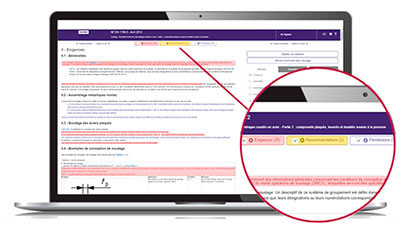
ZOOM ON ... the Requirements department
To comply with a standard, you need to quickly understand its issues in order to determine its impact on your activity.

The Requirements department helps you quickly locate within the normative text:
- mandatory clauses to satisfy,
- non-essential but useful clauses to know, such as permissions and recommendations.

The identification of these types of clauses is based on the document “ISO / IEC Directives, Part 2 - Principles and rules of structure and drafting of ISO documents ”as well as on a constantly enriched list of verbal forms.

With Requirements, quickly access the main part of the normative text!

With Requirements, quickly access the main part of the normative text!
New: UPSELL service
- The UPSELL service allows you to easily update one of your standards.
- With a single click, add a new language, the Requirements or Redline+ service and add one or more additional users.
- Whether you are in the process of acquiring a standard or it is already available in your personal space, the UPSELL service is available at every stage to help you understand it and implement it within your organization.
Need to identify, monitor and decipher standards?

COBAZ is the simple and effective solution to meet the normative needs related to your activity, in France and abroad.

Available by subscription, CObaz is THE modular solution to compose according to your needs today and tomorrow. Quickly discover CObaz!

Request your free, no-obligation live demo

I discover COBAZ