NF EN ISO/CIE 11664-4

NF EN ISO/CIE 11664-4

July 2019
Standard Current

Colorimetry - Part 4 : CIE 1976 L*a*b* colour space

This document specifies a method of calculating the coordinates of the CIE 1976 L*a*b* colour space, including correlates of lightness, chroma and hue. It includes two methods for calculating Euclidean distances in this space to represent the perceived magnitude of colour differences.This document is applicable to tristimulus values calculated using colour-matching functions of the CIE 1931 standard colorimetric system or the CIE 1964 standard colorimetric system. This document can be used for the specification of colour stimuli perceived as belonging to a reflecting or transmitting object, where a three-dimensional space more uniform than tristimulus space is required. This document does not apply to colour stimuli perceived as belonging to an area that appears to be emitting light as a primary light source, or that appears to be specularly reflecting such light. This document is applicable to self-luminous displays, such as cathode ray tubes, if they are being used to simulate reflecting or transmitting objects and if the stimuli are appropriately normalized.Calculating the reverse transformation is shown in Annex A.

Main informations

Collections

National standards and national normative documents

Publication date

July 2019

Number of pages

18 p.

Reference

NF EN ISO/CIE 11664-4

ICS Codes

17.180.20   Colours and measurement of light

Classification index

T36-007-4

Print number

1

International kinship

ISO/CIE 11664-4:2019

European kinship

EN ISO 11664-4:2019
Sumary
Colorimetry - Part 4 : CIE 1976 L*a*b* colour space

This document specifies a method of calculating the coordinates of the CIE 1976 L*a*b* colour space, including correlates of lightness, chroma and hue. It includes two methods for calculating Euclidean distances in this space to represent the perceived magnitude of colour differences.

This document is applicable to tristimulus values calculated using colour-matching functions of the CIE 1931 standard colorimetric system or the CIE 1964 standard colorimetric system. This document can be used for the specification of colour stimuli perceived as belonging to a reflecting or transmitting object, where a three-dimensional space more uniform than tristimulus space is required.

This document does not apply to colour stimuli perceived as belonging to an area that appears to be emitting light as a primary light source, or that appears to be specularly reflecting such light.

This document is applicable to self-luminous displays, such as cathode ray tubes, if they are being used to simulate reflecting or transmitting objects and if the stimuli are appropriately normalized.

Calculating the reverse transformation is shown in Annex A.

Replaced standards (1)
NF EN ISO 11664-4
NF EN ISO 11664-4
June 2011
Standard Cancelled
Colorimetry

Table of contents
  • Avant-propos
  • 1 Domaine d'application
  • 2 Références normatives
  • 3 Termes et définitions
  • 4 Symboles et termes abrégés
  • 5 Méthode de calcul
  • Annexe A (informative) Transformation inverse
  • Bibliographie
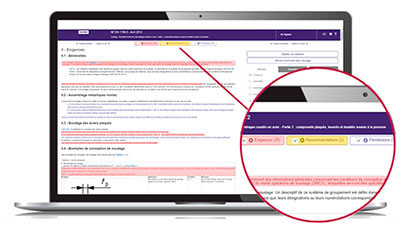
ZOOM ON ... the Requirements department

To comply with a standard, you need to quickly understand its issues in order to determine its impact on your activity.

The Requirements department helps you quickly locate within the normative text:

  • mandatory clauses to satisfy,
  • non-essential but useful clauses to know, such as permissions and recommendations.

The identification of these types of clauses is based on the document "ISO/IEC Directives, Part 2 - Principles and rules of structure and drafting of ISO documents" as well as on a constantly enriched list of verbal forms.

With Requirements, quickly access the main part of the normative text!


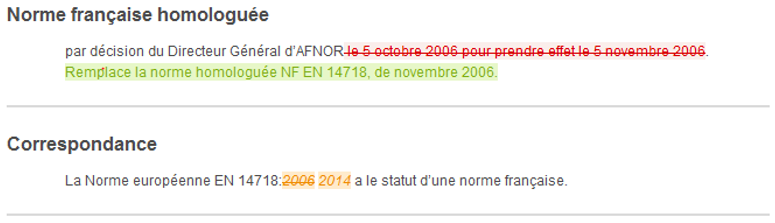
What is the Redline format?
New: UPSELL service
Need to identify, monitor and decipher standards?