
NF ETS 300542
NF ETS 300542

NF ETS 300542

July 1997
Standard Current

Digital cellular telecommunications system (Phase 2). Line identification supplementary service. Stage 2 (GSM 03.81).

Le présent document donne la description de l'étape 2 des compléments de service d'identification d'appel qui recouvrent l'Identification de la ligne appelante (CLIP), la Non-identification de la ligne appelante (CLIR) l'Identification de la ligne connectée (COLP) et la Non-identification de la ligne connectée (COLR) sur le système de télécommunications cellulaire numérique GSM.

Main informations

Collections

National standards and national normative documents

Publication date

July 1997

Number of pages

31 p.

Reference

NF ETS 300542

ICS Codes

33.030   Telecommunication services. Applications
33.070.50   Global System for Mobile Communication (GSM)

Classification index

Z83-542

Print number

1 - juillet 1997

European kinship

ETS 300542:1997
Sumary
Digital cellular telecommunications system (Phase 2). Line identification supplementary service. Stage 2 (GSM 03.81).

Le présent document donne la description de l'étape 2 des compléments de service d'identification d'appel qui recouvrent l'Identification de la ligne appelante (CLIP), la Non-identification de la ligne appelante (CLIR) l'Identification de la ligne connectée (COLP) et la Non-identification de la ligne connectée (COLR) sur le système de télécommunications cellulaire numérique GSM.
Table of contents
  • Avant-propos
    3
  • 0 Domaine d'application
    4
  • 0.1 Références normatives
    4
  • 0.2 Définitions et abréviations
    4
  • 1 Identification de la ligneappelante (CLIP)
    5
  • 1.1 Traitement de l'identification de la ligne appelante
    5
  • 1.2 Fonctions et flux d'information
    5
  • 1.3 Information mémorisée dans l'ELN
    8
  • 1.4 Modèle de transition d'état
    9
  • 1.5 Transfert d'information de l'ELN à l'ELV
    9
  • 1.6 Information mémorisée dans l'ELV
    9
  • 1.7 Transfert intercellulaire
    9
  • 2 Non-identification de la ligne appelante (CLIR)
    9
  • 2.1 Traitement de la non-identification de la ligne appelante
    9
  • 2.2 Fonctions et flux d'information
    11
  • 2.3 Information mémorisée dans l'ELN
    16
  • 2.4 Modèle de transition d'état
    16
  • 2.5 Transfert d'information de l'ELN à l'ELV
    16
  • 2.6 Information mémorisée dans l'ELV
    16
  • 2.7 Transfert intercellulaire
    16
  • 2.8 Interfonctionnement
    17
  • 3 Identification de la ligne connectée (COLP)
    17
  • 3.1 Traitement de l'identification de la ligne connectée
    17
  • 3.2 Fonctions et flux d'information
    18
  • 3.3 Information mémorisée dans l'ELN
    23
  • 3.4 Modèle de transition d'état
    23
  • 3.5 Transfert d'information de l'ELN à l'ELV
    23
  • 3.6 Information mémorisée dans l'ELV
    24
  • 3.7 Transfert intercellulaire
    24
  • 4 Non-identification de la ligne connectée (COLR)
    24
  • 4.1 Traitement de la non-identification de la ligne connectée
    24
  • 4.2 Fonctions et flux d'information
    24
  • 4.3 Information mémorisée dans l'ELN
    28
  • 4.4 Modèle de transition d'état
    28
  • 4.5 Transfert d'information de l'ELN à l'ELV
    28
  • 4.6 Information mémorisée dans l'ELV
    28
  • 4.7 Transfert intercellulaire
    28
  • 4.8 Interfonctionnement
    29
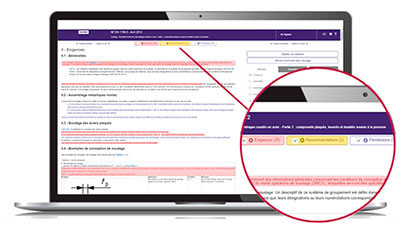
ZOOM ON ... the Requirements department

To comply with a standard, you need to quickly understand its issues in order to determine its impact on your activity.

The Requirements department helps you quickly locate within the normative text:

  • mandatory clauses to satisfy,
  • non-essential but useful clauses to know, such as permissions and recommendations.

The identification of these types of clauses is based on the document "ISO/IEC Directives, Part 2 - Principles and rules of structure and drafting of ISO documents" as well as on a constantly enriched list of verbal forms.

With Requirements, quickly access the main part of the normative text!


New: UPSELL service
Need to identify, monitor and decipher standards?