

NF ISO 10718
NF ISO 10718

NF ISO 10718

February 2016
Standard Current

Cork stoppers - Characterization of a low-in-germs stopper, through the enumeration of colony-forming units of yeasts, moulds and bacteria, capable of both, being extracted and growth in an alcoholic medium

ISO 10718:2015 specifies a method to enumerate the colony-forming units of yeasts, moulds and bacteria which can exist on cork stoppers and in an alcoholic solution, and which, under certain conditions, can be extracted during the 3 months following delivery.ISO 10718:2015 applies to all types of ready-to-use cork stoppers, submitted to a sanitation process and packaged in properly aseptic and hermetic conditions.ISO 10718:2015 specifies the limit values of the colony-forming units of yeasts, moulds and bacteria which can be found on cork stoppers submitted to the test procedures included in this standard.

Main informations

Collections

National standards and national normative documents

Publication date

February 2016

Number of pages

12 p.

Reference

NF ISO 10718

ICS Codes

07.100.99   Other standards related to microbiology
55.100   Bottles. Pots. Jars
79.100   Cork and cork products

Classification index

B57-107

Print number

1

International kinship

ISO 10718:2015
Sumary
Cork stoppers - Characterization of a low-in-germs stopper, through the enumeration of colony-forming units of yeasts, moulds and bacteria, capable of both, being extracted and growth in an alcoholic medium

ISO 10718:2015 specifies a method to enumerate the colony-forming units of yeasts, moulds and bacteria which can exist on cork stoppers and in an alcoholic solution, and which, under certain conditions, can be extracted during the 3 months following delivery.

ISO 10718:2015 applies to all types of ready-to-use cork stoppers, submitted to a sanitation process and packaged in properly aseptic and hermetic conditions.

ISO 10718:2015 specifies the limit values of the colony-forming units of yeasts, moulds and bacteria which can be found on cork stoppers submitted to the test procedures included in this standard.

Table of contents
  • 1 Domaine d'application
  • 2 Références normatives
  • 3 Bouchons pauvres en germes
  • 4 Principe
  • 5 Réactifs et milieux de culture
  • 6 Appareillage
  • 7 Échantillonnage
  • 8 Conditions d'essai
  • 9 Extraction
  • 10 Modes opératoires
  • 11 Essai à blanc
  • 12 Incubation
  • 13 Expression des résultats
  • 14 Rapport d'essai
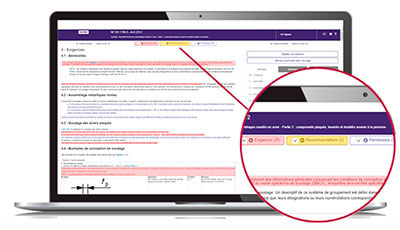
ZOOM ON ... the Requirements department

To comply with a standard, you need to quickly understand its issues in order to determine its impact on your activity.

The Requirements department helps you quickly locate within the normative text:

  • mandatory clauses to satisfy,
  • non-essential but useful clauses to know, such as permissions and recommendations.

The identification of these types of clauses is based on the document "ISO/IEC Directives, Part 2 - Principles and rules of structure and drafting of ISO documents" as well as on a constantly enriched list of verbal forms.

With Requirements, quickly access the main part of the normative text!


New: UPSELL service
Need to identify, monitor and decipher standards?