NF ISO 13196
NF ISO 13196

NF ISO 13196

May 2013
Standard Cancelled

Soil quality - Screening soils for selected elements by energy dispersive X-ray fluorescence spectrometry using a handheld or portable instrument

ISO 13196:2013 specifies the procedure for screening soils and soil-like materials for selected elements when handheld or portable energy-dispersive XRF spectrometers are used. This quick method is assumed to be applied on-site to obtain qualitative or semiquantitative data that assists decisions on further sampling strategy for assessing soil quality. The higher the efforts for pretreatment used on soil samples, the better the analytical results can be expected.ISO 13196:2013 does not explicitly specify elements for which it is applicable, since the applicability depends on the performance of the apparatus and the objective of the screening. The elements which can be determined are limited by the performance of the instruments used, the concentration of the element present in the soil, and the requirements of the investigation (e.g. guideline value).For Hg, Cd, Co, Mo, V and Sb, a majority of instruments are not sensitive enough to reach sufficiently low limits of quantification (LOQ) to meet the requirements (limit or threshold values) set in the ordinances of different countries. In this case, other methods need to be employed to measure these low concentrations. Usually, wet chemical methods are used, based on aqua regia extracts, in combination with optical or mass spectrometric (MS) methods like atomic absorption spectrometry (AAS), inductively coupled plasma/optical emission spectrometry (ICP/OES) or ICP/MS.


Main informations

Collections

National standards and national normative documents

Publication date

May 2013

Number of pages

20 p.

Reference

NF ISO 13196

ICS Codes

13.080.10   Chemical characteristics of soils

Classification index

X31-013

Print number

1 - avril 2013

International kinship

ISO 13196:2013
Sumary
Soil quality - Screening soils for selected elements by energy dispersive X-ray fluorescence spectrometry using a handheld or portable instrument

ISO 13196:2013 specifies the procedure for screening soils and soil-like materials for selected elements when handheld or portable energy-dispersive XRF spectrometers are used. This quick method is assumed to be applied on-site to obtain qualitative or semiquantitative data that assists decisions on further sampling strategy for assessing soil quality. The higher the efforts for pretreatment used on soil samples, the better the analytical results can be expected.

ISO 13196:2013 does not explicitly specify elements for which it is applicable, since the applicability depends on the performance of the apparatus and the objective of the screening. The elements which can be determined are limited by the performance of the instruments used, the concentration of the element present in the soil, and the requirements of the investigation (e.g. guideline value).

For Hg, Cd, Co, Mo, V and Sb, a majority of instruments are not sensitive enough to reach sufficiently low limits of quantification (LOQ) to meet the requirements (limit or threshold values) set in the ordinances of different countries. In this case, other methods need to be employed to measure these low concentrations. Usually, wet chemical methods are used, based on aqua regia extracts, in combination with optical or mass spectrometric (MS) methods like atomic absorption spectrometry (AAS), inductively coupled plasma/optical emission spectrometry (ICP/OES) or ICP/MS.
Standard replaced by (1)
NF EN ISO 13196
NF EN ISO 13196
September 2015
Standard Cancelled
Soil quality -- Screening soils for selected elements by energy-dispersive X-ray fluorescence spectrometry using a handheld or portable instrument

Le présent document spécifie la procédure d''analyse rapide d''une sélection d''éléments dans les sols et matériaux similaires lorsque l''on utilise des spectromètres XRF à dispersion d''énergie portables ou portatifs. Cette méthode rapide est supposée être appliquée sur site pour obtenir des données qualitatives ou semi-quantitatives qui aident notamment à décider de la stratégie d''échantillonnage plus poussée pour évaluer la qualité du sol. Plus les efforts de traitement préalable des échantillons de sol sont importants, plus on peut s''attendre à des résultats d''analyse de qualité.

Table of contents
  • Avant-propos
    iv
  • Introduction
    v
  • 1 Domaine d'application
    1
  • 2 Références normatives
    1
  • 3 Termes et définitions
    1
  • 4 Principe
    2
  • 5 Appareillage
    2
  • 6 Procédure
    3
  • 6.1 Généralités
    3
  • 6.2 Contrôle de performance des instruments
    3
  • 6.3 Étalonnage (calibration)
    3
  • 6.4 Mesurage in situ
    3
  • 6.5 Analyse de sol avec échantillonnage
    4
  • 7 Contrôle de la qualité
    4
  • 7.1 Test de performance avec des matériaux de référence étalons
    4
  • 7.2 Étalonnage de l'énergie
    5
  • 8 Rapport d'essai
    5
  • Annexe A (informative) Données de fidélité
    6
  • Bibliographie
    12
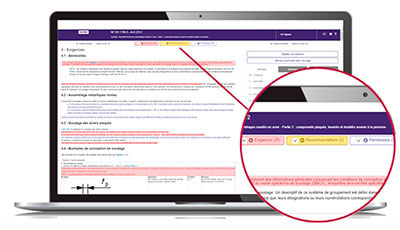
ZOOM ON ... the Requirements department

To comply with a standard, you need to quickly understand its issues in order to determine its impact on your activity.

The Requirements department helps you quickly locate within the normative text:

  • mandatory clauses to satisfy,
  • non-essential but useful clauses to know, such as permissions and recommendations.

The identification of these types of clauses is based on the document "ISO/IEC Directives, Part 2 - Principles and rules of structure and drafting of ISO documents" as well as on a constantly enriched list of verbal forms.

With Requirements, quickly access the main part of the normative text!


New: UPSELL service
Need to identify, monitor and decipher standards?